A new roof in Norwich costs £6,500-11,500 for a concrete-tile 3-bed semi, £9,500-15,500 in clay pantile, and up to £18,500 in Welsh slate. Price depends on roof area, pitch, material and timber condit
A new roof in Norwich costs £6,500-11,500 for a concrete-tile 3-bed semi, £9,500-15,500 in clay pantile, and up to £18,500 in Welsh slate. Price depends on roof area, pitch, material and timber condition. Every quote includes a free survey and written breakdown. Call 0160 339 6191.
✓NFRC Registered
✓Fully Insured £2m
✓10-Year Guarantee
✓Free Quotes
✓No Hidden Costs
Roof Replacement · Norwich
What a New Roof Actually Costs in Norwich
A full roof replacement in Norwich in 2026 costs £6,500-11,500 for a standard 3-bed semi in concrete interlocking tile, £9,500-15,500 in clay pantile, and £11,000-18,500 in natural Welsh slate. These are supplied-and-fitted figures including strip-off, disposal, new breathable membrane, new battens, ridge and verge work, and scaffolding. East Anglia sits at the national baseline for labour — Norwich does not carry the 20-30% uplift that applies in London and the South East, which keeps re-roofing here more affordable than in the Home Counties.
The Four Things That Move the Price
Four variables account for almost all the difference between quotes: roof area and pitch, the covering material, scaffold access, and whether the timbers underneath are sound. A steeper or cut-up roof with multiple hips, valleys and dormers costs more per square metre than a simple gable roof. Clay pantile — the traditional Norwich material — costs more than concrete but lasts far longer. Restricted terrace access in the Golden Triangle or Lakenham adds scaffold cost. And rotten rafter feet or wall plates, common on pre-1950 Norwich stock, are found at survey and must be included honestly rather than sprung on you mid-job.
Per Square Metre Rates for Norwich Properties
Priced by area, expect roughly £85-170/m² for concrete tile, £110-210/m² for clay pantile, and £140-280/m² for natural Welsh slate — all supplied and fitted with new battens, membrane and scaffolding. The reason you see two different-looking figures quoted is that some rates are covering-material-only and some are the full installed rate. Always confirm which you are being quoted. A genuine quote for a Norwich re-roof itemises scaffold, timber allowance, membrane, battens and disposal as separate lines, not a single lump.
Re-roofing an existing residential property in the UK usually qualifies for a reduced 5% VAT rate rather than the standard 20%, provided the work meets HMRC conditions.
— HMRC VAT Notice 708
Local Knowledge · Norwich
Why Clay Pantile Costs More — and Is Usually Worth It
Clay pantile is the defining roof material of historic Norwich, and on a period property it is frequently the only appropriate — and in conservation areas the only permitted — specification. Clay costs 40-60% more than concrete per square metre, but it lasts 80-120 years against concrete's 30-50, meaning the cheaper covering needs replacing again within the life of a single clay roof. On period Norwich terraces, estate agents consistently report correctly-matched clay pantile as a positive sale attribute, which recovers part of the premium at resale.
Extras That Catch Norwich Homeowners Out
Beyond the headline re-roof figure, several extras commonly apply. Chimney re-flashing adds £250-600 per stack — most Norwich Victorian and Edwardian properties have at least one. Each rooflight or dormer adds £300-1,500 in cutting, flashing and detailing. Structural timber repair, found at survey on older stock, is priced separately. On the positive side, re-roofing an existing home usually qualifies for the reduced 5% VAT rate rather than 20% — always confirm this in writing with your contractor before work begins.
Repair or Replace — Making the Call in Norwich
A local repair is cheaper when damage is limited to a few tiles or a single flashing. Replacement offers better value when the covering, underlay and several details are failing across the whole roof, when the roof is past its design life, or when repeated repairs are no longer lasting. On Norwich's 1950s-70s estate housing, the tipping point is usually widespread nail sickness combined with perished underlay — at that stage, re-fixing buys a few years but full replacement is the better 20-year investment. We give an honest repair-versus-replace assessment at every survey.
How Long Does a New Roof Last in Norwich?
Roof lifespan depends heavily on material, and it is central to the value calculation. A concrete interlocking tile roof, the cheapest option, has a realistic life of 30-50 years in Norfolk's climate. Clay pantile — the traditional Norwich covering — lasts 80-120 years, comfortably outliving two concrete roofs. Natural Welsh slate can exceed 100 years and is frequently the original covering still in place on Norwich's Victorian and Edwardian stock. When you divide the installed cost by the expected life, the more expensive materials often work out cheaper per year, which is why we always present the whole-life cost rather than just the headline price at survey.
Financing and Timing Your Norwich Re-Roof
A full re-roof is a significant outlay, and timing it well saves money and stress. The best time to replace a Norwich roof is before it fails, not after — an emergency re-roof forced by a collapsed ceiling costs more and offers no time to source materials or compare quotes. If your roof is nearing the end of its life, planning the work for spring or summer gives better weather windows and more contractor availability than the autumn rush when everyone's roof starts leaking. We are happy to survey a roof that is not yet failing and give you an honest timeline, so you can budget and plan rather than react to a crisis.
Choosing the Right Material for Your Norwich Property
Beyond cost, the right roof covering for your Norwich home depends on the property's age, character and setting. On a period terrace in a conservation area, clay pantile or Welsh slate is often the only appropriate — and sometimes the only permitted — choice, and a modern concrete tile would look wrong and may breach conservation guidance. On a post-war or modern estate house, concrete interlocking tile is entirely appropriate and the sensible economical choice. Between these, matching the existing roofs on your street matters for both appearance and, on terraces, the continuity of the roofline. We advise on the material that suits your specific property rather than simply quoting the cheapest, because a roof that looks wrong or breaches conservation rules is a false economy however little it cost.
Pricing · Norwich & Norfolk
Roof Replacement Prices in Norwich
£6,500-11,500
Concrete Tile Semi
Full re-roof, 3-bed, supplied & fitted
£9,500-15,500
Clay Pantile Semi
Traditional Norwich material
£11,000-18,500
Welsh Slate Semi
Period & Edwardian properties
£85-280/m²
Per Square Metre
By material, installed
Free survey and written quote — no call-out fee, no obligation
A full re-roof is a major investment, so the honest first question is whether you actually need one yet. Replacement is right when the covering, underlay and multiple details are failing across the whole roof — not when a good repair would do.
Widespread slipped tiles from nail sickness across the whole roof
The roof is past its material design life (30–50yr concrete, 80–120yr clay)
Perished, crumbling underlay visible in the loft
Repeated repairs that no longer hold
Sagging roofline or visible dips in the ridge
When it is not the answer: If the covering is sound and only a few tiles or one detail have failed, a targeted repair is the right call — replacing a serviceable roof is oversell. Read the full guide.
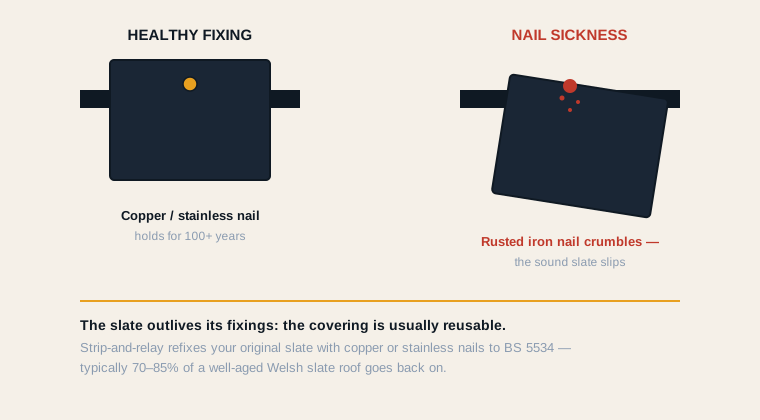
Nail sickness: corroded fixings let sound tiles slip — the classic re-roof trigger.The process
From First Call to Sign-Off
1. Survey & timber inspection
We assess the covering, underlay, battens and — critically on older Norwich stock — the rafter feet and wall plates for hidden decay.
2. Detailed written quotation
You get an itemised quote with the covering named, and scaffold, timber allowance, membrane and disposal shown as separate lines.
3. Scheduling
We book the job with realistic weather margin and confirm scaffold and skip arrangements in advance.
4. Strip & re-roof
We strip the old covering, replace defective timber, fit new breathable membrane, battens and your chosen tile or slate with dry-fix ridge and verge.
5. Completion & sign-off
We complete to specification, clear the site fully, and hand over the written 10-year guarantee and documentation.
Timescales
Typical Timescales
Job
Typical duration
3-bed semi, concrete tile
3–5 days
3-bed semi, clay pantile
4–7 days
Larger detached / complex roof
5–8 days
Scaffold up for
5–10 days total
Extended wet or windy spells can add days — we never rush a re-roof in poor weather and keep the roof weathertight overnight throughout.
Access
Getting Safely onto Norwich Roofs
A full re-roof always needs scaffold for safe working and materials handling; it is a fixed, itemised line in the quote. Scaffold is specified for: the entire job — full perimeter scaffold is standard on any re-roof - always itemised in your written quote, never a hidden extra, and we arrange it.
Norwich’s medieval core and Golden Triangle terraces mean tight street frontages, rear-access-only roofs and permit-controlled pavement space for scaffold. Pavement scaffold and skip permits go through Norwich City Council; allow a few working days on streets like Elm Hill, Magdalen Street, Gentleman’s Walk where space is tight.
Pricing
Roof Replacement Prices in Norwich
Job
Typical range
Notes
Concrete tile re-roof, 3-bed semi
£6,500–£11,500
Supplied & fitted, incl. scaffold
Clay pantile re-roof, 3-bed semi
£9,500–£15,500
Traditional Norwich material
Welsh slate re-roof, 3-bed semi
£11,000–£18,500
Period & Edwardian stock
Per square metre (installed)
£85–£280/m²
By material
Chimney re-flash (per stack, adds)
£250–£600
Most period homes need it
What moves the price
Covering material (clay and slate cost more than concrete)
Roof size, pitch and complexity (hips, valleys, dormers)
Hidden timber decay found at survey on older stock
Scaffold access on terraced or restricted sites
Worked example: A clay pantile re-roof on a 1930s Eaton semi, including new membrane, dry-fix ridge and full scaffold: around £12,500, qualifying for reduced-rate VAT.
Staged payments on re-roofs — nothing up front before materials are on site. Re-roofing an existing home usually qualifies for reduced-rate VAT, confirmed in writing before work begins.
The full re-roof carries a 10-year written workmanship guarantee, transferable if you sell; tiles, slate and membrane carry manufacturer warranties (often 15–30 years) on top.
Covered: workmanship for 10 years, in writing, transferable if you sell.
On top: manufacturer warranties on materials (terms vary by product).
Not covered: storm or impact damage - that is an insurance matter, and we will document it for your claim.
If a fault appears in covered work, we come back and put it right. No quibbling, no re-charge.
Re-roofing an existing residential property usually qualifies for a reduced 5% VAT rate rather than the standard 20%, subject to HMRC conditions.
— HMRC VAT Notice 708
Good to know
Disruption, Mess & Weather
A re-roof is the most disruptive job we do — scaffold up for a week or more, noise during strip-off, and a skip on site. We protect planting and paths and agree everything in advance. You do not need to stay home for external work - we just need power and access agreed in advance.
Re-roofing runs spring through autumn ideally; we keep the roof weathertight each night and pause tiling in high wind or heavy rain. Norfolk’s exposure to north-easterly gales off the North Sea, and Wensum valley humidity, drive wind-lifted tiles and slower autumn drying.
"Full re-roof on our 1930s semi in Eaton. Concrete tile, new membrane and battens, rotten fascia replaced. Quote was itemised and the final invoice matched it exactly — no surprises."
Gordon M.Eaton, NR4
★★★★★
"Re-roofed our Golden Triangle terrace in matched clay pantile. They explained the conservation area requirements and the VAT position clearly before we committed. First-rate work."
Yvonne P.Golden Triangle, NR2
★★★★★
"Got three quotes for a new roof. This was the most detailed survey by a distance — they found timber issues the others missed. Fair price and a proper written guarantee."
Ken R.Sprowston, NR7
FAQs · Norwich
Roof Replacement Norwich — Common Questions
A standard 3-bed semi costs £6,500-11,500 in concrete tile, £9,500-15,500 in clay pantile, or £11,000-18,500 in Welsh slate, supplied and fitted including scaffolding. Larger or complex roofs cost more. Free survey and written quote before any work.
Clay pantile costs 40-60% more per square metre but lasts 80-120 years against concrete's 30-50. On period Norwich properties and in conservation areas, clay is frequently the only appropriate or permitted material.
A like-for-like re-roof using the same material is permitted development and does not require planning permission, though it must meet current Building Regulations. Material changes on conservation area properties do require consent. We check this at survey.
Yes. Safe access is a legal requirement for working at height, so scaffolding is always shown as a line in our written quote. If a quote you receive omits scaffold, ask why before accepting it.
Re-roofing an existing residential property usually qualifies for the reduced 5% VAT rate rather than 20%, subject to HMRC conditions. We confirm the applicable rate in writing before any work begins.
A standard 3-bed semi takes 3-5 days for concrete tile, 4-7 days for clay pantile with sourcing, and 5-8 days for larger detached properties. Scaffold is typically up for 5-10 days in total.
Roof area and pitch, covering material, scaffold access, and the condition of the timbers underneath. Two identical-looking Norwich semis can differ by thousands if one has rotten rafter feet and the other does not.
Yes — every survey and written quote is free with no obligation and no call-out fee. We survey from the roof surface, not just the ground, so the quote reflects the true condition. Call 0160 339 6191.