The honest framework for deciding — by age, condition and your Norwich property’s stock era. When patching is money wasted, and when replacement is oversell. Both ways, no pressure.
Tell us the job in 30 seconds. No pushy sales, no call-out fee.
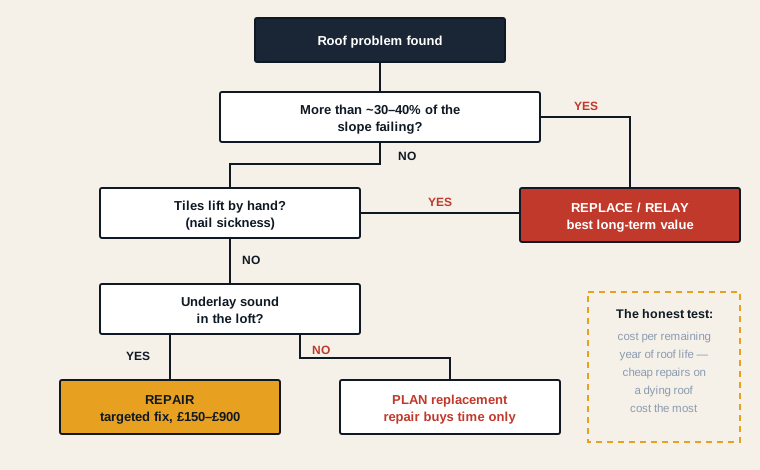
📞 Call Now: 0160 339 6191Repair when the covering is largely sound and only a few tiles or one detail have failed; replace when failure is widespread — nail sickness across the roof, perished underlay, or repeated repairs that no longer hold. The 30% rule of thumb: once more than about a third of the covering has failed, a re-roof usually gives better long-term value.
The right answer depends heavily on what you have. Norwich’s Victorian and Edwardian terraces — the Golden Triangle, Heigham, Lakenham — carry Welsh slate that usually outlives its nails: here the answer is nearly always strip-and-relay refixing your original slate, not new slate. The 1930s semis of Eaton and the inter-war estates carry clay pantile and early concrete tile now reaching the age where nail sickness and ridge failure spread across the whole roof — the classic re-roof trigger. Post-war and 1960s–70s estate housing in Sprowston, Costessey and the outer suburbs carries concrete interlocking tile at 30–50 years, exactly the window where the repair-versus-replace decision bites. Knowing the era tells us where on the curve your roof sits.
The single most useful test is cost per remaining year of roof life. A £400 repair that buys two more years costs £200 a year. A £12,000 re-roof that lasts fifty years costs £240 a year — and gives you fifty years, not two. On a young roof with a single fault, repair wins overwhelmingly. On a dying roof, cheap repairs are the most expensive option per year because you keep paying and the roof keeps failing.
| Situation | Usually the answer |
|---|---|
| Few slipped tiles, sound covering | Repair |
| One failed valley or flashing | Repair |
| Sound Welsh slate slipping (nail sickness) | Strip & relay original slate |
| Widespread nail sickness, perished underlay | Replace |
| Repeated repairs that no longer hold | Replace |
We do this maths with you honestly — including telling you when replacement would be oversell.
Whether you repair or replace, our workmanship carries a 10-year written guarantee, transferable if you sell.
If a fault appears in covered work, we come back and put it right. No quibbling, no re-charge.
A roof’s remaining service life should be judged on the condition of the covering, fixings and underlay together — not the age of the tiles alone, since fixings often fail while the covering remains sound.
— RICS / BRE stock-condition guidance
Repair is the right answer far more often than a salesperson would admit. If your covering is largely sound and the problem is localised — a handful of slipped tiles, one failed valley, a leaking chimney flashing, a cracked ridge — a targeted repair restores the roof for years at a fraction of replacement cost. On Norwich’s Victorian and Edwardian slate roofs, even widespread slipping is usually a fixing problem, not a slate problem: strip-and-relay refixes 70–85% of your original Welsh slate with new copper or stainless nails, which is a repair philosophy, not a replacement. Repairing a roof that has decades of life left in its covering is simply good economics, and we will always tell you when that is the case.
Sometimes replacement genuinely is the honest answer. When nail sickness has spread across the whole roof, when the underlay has perished, when you are paying for repair after repair that no longer holds, or when the covering has simply reached the end of its design life, continuing to patch is throwing good money after bad. A concrete tile roof at 45–50 years, an inter-war roof whose every fixing is failing at once — these are re-roof territory. Replacement also resets the clock: a new roof with new membrane, dry-fix ridge and verge, and a fresh covering gives you 30–100+ years depending on material, plus a transferable guarantee that reassures buyers and surveyors. When the maths and the condition point that way, we say so.
The two failures we see most are opposite. Some traders oversell — pushing a full re-roof on a roof that needed a £400 repair, because a re-roof is a bigger invoice. Others under-repair — selling cheap patch after cheap patch on a dying roof, because each individual repair looks affordable, when the honest advice was to replace and stop the bleeding. Both cost the homeowner more than the honest answer would. Our test cuts through both: what is the cost per remaining year of roof life? That single question, applied honestly to the actual condition of your covering, fixings and underlay, gives the right answer nearly every time — and it is the question we answer with you at the free survey.
Two situations change the calculation. First, storm damage: if wind or impact caused the failure, it may be an insurance matter rather than a wear-and-tear repair, and we document damage for your claim either way. Second, selling: a roof visibly at the end of its life will be flagged by a buyer’s surveyor and used to chip the price, so on stock nearing replacement, doing the re-roof before sale can protect your asking price and speed the sale. If you are staying put with a sound covering, though, none of that applies — a simple repair keeps you dry and keeps your money in your pocket. We factor your actual situation into the advice.
Knowing the design life of your covering anchors the whole decision. Concrete interlocking tile — the post-war and estate standard across Sprowston, Costessey and the outer suburbs — lasts 30–50 years, though the fixings often fail before the tile. Clay pantile, the traditional Norwich covering on period and inter-war stock, lasts 80–120 years and can frequently be re-fixed and reused rather than replaced. Welsh slate on the Victorian and Edwardian terraces lasts 80–120 years and, because the slate outlives its nails, is nearly always a strip-and-relay candidate rather than a full replacement. Felt flat roofs last 15–20 years; GRP and EPDM 20–30. Set your roof’s actual age against these figures, factor in the condition of the fixings and underlay, and the repair-or-replace answer usually becomes clear.
Choosing a tile? See clay vs concrete tiles.
When the covering is largely sound and only a few tiles, one valley or one detail has failed. A targeted repair on an otherwise good roof is money well spent — replacing it would be oversell.
When failure is widespread — nail sickness across the whole roof, perished underlay, repeated repairs that no longer hold, or a covering past its design life. At that point repairs are throwing good money after bad.
A rule of thumb: if more than about 30–40% of the roof covering has failed, a re-roof usually gives better long-term value than continuing to repair tile-by-tile.
Concrete tile 30–50 years, clay pantile 80–120 years, Welsh slate 80–120 years — but fixings (nails) often fail first, which is why sound slate roofs are stripped and relaid rather than replaced.
It depends on cost per remaining year. A cheap repair on a roof with two years left costs more per year than a re-roof with fifty years left. We do the honest maths with you.
Yes. We will tell you when a repair is enough and when replacement is oversell, just as we will tell you when repairs are wasted money. Honest advice both ways is the point.
A sound roof protects everything below it and reassures buyers and surveyors. On stock nearing the end of its covering life, replacement is both protection and a selling point.
Free survey, written quote and a 10-year workmanship guarantee. Call now — no call-out fee.
0160 339 6191📅 Get My Free Quote