Dry verge and dry ridge systems in Norwich replace failed mortar bedding on verges and ridges with mechanical dry-fix, from £250 per gable and £400-900 for a full dry ridge. Ideal for the cracked verg
Dry verge and dry ridge systems in Norwich replace failed mortar bedding on verges and ridges with mechanical dry-fix, from £250 per gable and £400-900 for a full dry ridge. Ideal for the cracked verge mortar common on post-war Norwich estates. BS 8612 compliant, 40-year system life. Call 0160 339 6191.
✓NFRC Registered
✓Fully Insured £2m
✓10-Year Guarantee
✓Free Quotes
✓No Hidden Costs
Dry Verge and Dry Ridge · Norwich
Dry Verge and Dry Ridge in Norwich
Dry verge and dry ridge systems mechanically fix the verge and ridge tiles of a roof using screws, clips and unions instead of mortar bedding. On Norwich's large stock of post-war concrete-tile housing, the original mortar bedding along the gable verges and the ridge line has reached the end of its life — cracking, crumbling and letting tiles work loose. Replacing failed mortar with a dry-fix system costs from £250 per gable verge or £400-900 for a full dry ridge, and eliminates the recurring mortar failure permanently with a system designed to last the life of the roof.
Why Verge and Ridge Mortar Fails on Norwich Estates
The concrete-tile estates built across Norwich from the 1950s to the 1980s — Mile Cross, Costessey, Sprowston, parts of Thorpe St Andrew — were finished with mortar-bedded verges and ridges, the standard method of the era. That mortar has now had 40-70 years of Norfolk weather: freeze-thaw cycling, thermal movement and wind exposure crack it, it loses its grip, and the verge and ridge tiles it holds begin to loosen and slip. Once the mortar goes, wind gets under the tiles, and on an exposed gable a loose verge tile can be lifted clean off in a north-easterly gale.
The Dry Verge System
A dry verge system is a set of interlocking units, usually uPVC, that clip and screw over the gable-end tiles, mechanically securing them and providing a neat, weathertight, maintenance-free edge. It removes the mortar entirely, so there is nothing left to crack or wash out. On Norwich's exposed gable ends — particularly the wind-funnelled elevations on the more open outer estates and higher ground — a dry verge is far more secure than re-bedded mortar and does not need redoing every couple of decades. Per gable, a dry verge runs £250-600 depending on the roof.
Since the 2018 revision of BS 5534, mechanical fixing of ridge and verge tiles is effectively mandatory, with BS 8612 setting the standard for dry-fixed ridge, hip and verge systems.
— BS 8612 / BS 5534 (2018)
Local Knowledge · Norwich
Dry Ridge Systems
A dry ridge system does the same job along the ridge line — the horizontal apex of the roof. Instead of bedding the ridge tiles in mortar, they are mechanically fixed to a batten with clamps and screws, and a ventilated ridge roll seals the joint while allowing the roof to breathe. Re-bedding a ridge in fresh mortar is the cheaper short-term fix at £200-500, but the mortar will crack again; a full dry ridge at £400-900 is the permanent solution and adds roof-space ventilation as a bonus. On exposed Norwich roofs the dry ridge's storm resistance is a real advantage.
Nail Sickness and Verge Failure Together
On many Norwich post-war estates, verge and ridge mortar failure arrives at the same time as nail sickness — the corrosion of the tile-fixing nails across the main roof. This is not a coincidence; both are age-related failures reaching their end of life together on 40-60 year old roofs. Where we find both, it is often more cost-effective to address them together, and sometimes the honest advice is that a roof with widespread nail sickness and failed verge and ridge mortar is approaching the point where re-roofing is the better investment than piecemeal repair. We assess the whole roof and advise accordingly.
BS 8612 and Modern Fixing Standards
Dry-fix is not just a convenience — it is now the standard. Since the 2018 revision of BS 5534, the code of practice for slating and tiling, mechanical fixing of ridge and verge tiles is effectively mandatory on new and re-roofing work, and BS 8612 sets the standard specifically for dry-fixed ridge, hip and verge systems. Mortar-only bedding no longer meets the standard. When we fit a dry verge or dry ridge on your Norwich roof, the work complies with current British Standards, which matters both for durability and for the roof's status on any future survey or sale.
Dry Verge vs Re-Bedding — the Long View
When verge or ridge mortar fails on a Norwich roof, re-bedding in fresh mortar is the cheaper immediate fix, but the long view favours a dry system. Re-bedded mortar is subject to exactly the same freeze-thaw cycling, thermal movement and wind that cracked the original, and on an exposed Norwich gable it will typically fail again within ten to fifteen years. A mechanical dry-verge or dry-ridge system removes mortar from the equation entirely, is designed to last the life of the roof, and meets the current British Standard that mortar-only bedding no longer satisfies. Over the lifetime of a roof, the dry system usually costs less than repeated re-bedding, and it holds far better in the gales that Norfolk regularly sees.
Combining Dry-Fix With Other Roof Work
Dry-verge and dry-ridge work is frequently most economical when combined with other roofing on the same visit, because the access is already in place. If your Norwich roof needs a re-fix of nail-sick tiles, a dry ridge fits naturally alongside; if the roofline is being replaced, the verge detail can be upgraded to dry-fix at the same time. And where a survey shows the whole roof is near the end of its life, incorporating dry-fix ridge and verge into a full re-roof is standard practice under the current standard and adds ventilation as a bonus. We assess the whole roof and advise where combining work saves you money rather than treating the verge in isolation.
Pricing · Norwich & Norfolk
Dry Verge and Dry Ridge Prices in Norwich
£250-600
Dry Verge Per Gable
Mechanical gable-edge fix
£200-500
Ridge Re-bed
Mortar — cheaper, temporary
£400-900
Full Dry Ridge
Permanent, ventilated
40yr
System Life
BS 8612 compliant
Free survey and written quote — no call-out fee, no obligation
Most roof problems announce themselves before they become expensive. The question is whether you have a localised fault worth repairing, or a covering nearing the end of its life where repair is throwing good money after bad.
A damp patch or brown stain on an upstairs ceiling after rain
Tiles or slates visibly slipped, cracked or missing
Debris (mortar, tile fragments) in the gutters or on the ground
Daylight visible through the roof in the loft
Water tracking down a chimney breast
When it is not the answer: If more than about a third of the covering has failed, or the whole roof shows nail sickness, repairing tile-by-tile is money wasted — a re-roof is the better long-term value. Read the full guide.
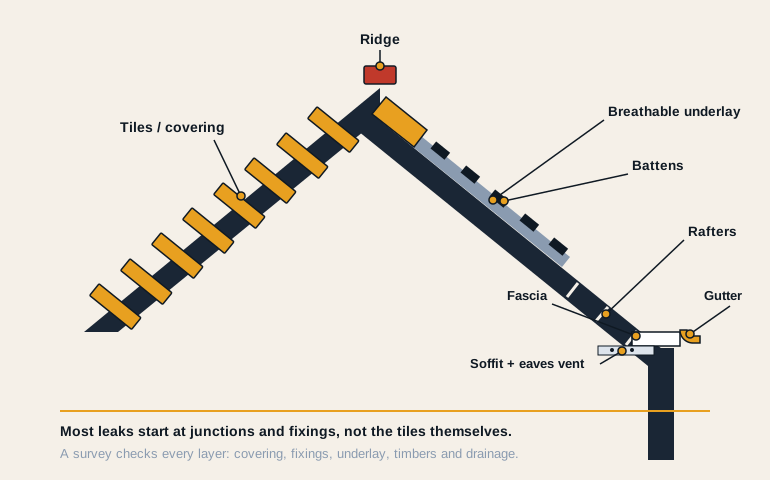
Cross-section of a pitched roof showing every layer a repair checks.The process
From First Call to Sign-Off
1. Survey
We inspect the roof from the surface, not just the ground, and check the loft where accessible to find the actual fault and any related issues.
2. Written itemised quote
You receive a written quote naming the repair, the materials, the access method and the guarantee — no vague single figure.
3. Scheduling
We book a date that suits, with weather margin built in, and confirm access arrangements beforehand.
4. The repair
We carry out the repair using matched materials, working from safe access appropriate to your property.
5. Cleanup & sign-off
We clear all debris, leave the site tidy, and hand over the written 10-year workmanship guarantee.
Timescales
Typical Timescales
Job
Typical duration
Slipped or cracked tiles
1–2 hours
Chimney flashing repair
Half a day to a day
Rear valley or back-gutter rebuild
2–3 days
Emergency make-safe
Same day, 2–4 hours to attend
Wet or high-wind days pause work at height — we build weather margin into every booking and fit temporary weatherproofing if rain stops play mid-job.
Access
Getting Safely onto Norwich Roofs
Most repairs run from roof ladders or a tower; scaffold is quoted only where the job needs safe standing time at height. Scaffold is specified for: chimney-side repairs, full valley rebuilds, and anything beyond a day working at height - always itemised in your written quote, never a hidden extra, and we arrange it.
Norwich’s medieval core and Golden Triangle terraces mean tight street frontages, rear-access-only roofs and permit-controlled pavement space for scaffold. Pavement scaffold and skip permits go through Norwich City Council; allow a few working days on streets like Elm Hill, Magdalen Street, Gentleman’s Walk where space is tight.
Pricing
Roof Repairs Prices in Norwich
Job
Typical range
Notes
Slipped or cracked tile refix
£150–£250
Per visit, incl. access
Chimney flashing repair
£250–£500
Re-lead and point
Ridge / verge re-bed (section)
£200–£450
Mortar or dry-fix
Valley or back-gutter rebuild
£400–£900
Common on Victorian terraces
Emergency make-safe
From £150
2–4hr response, credited vs repair
What moves the price
Roof height and access (three-storey terraces cost more)
Worked example: A slipped-tile and failed-valley repair on a Heigham Victorian terrace, worked from a tower: around £480 including access and matched pantiles.
No deposit on repairs under £500. Nothing is due before materials are on site. Re-roofs move to staged payments. Existing-home repairs may qualify for reduced-rate VAT — confirmed in writing before work.
Workmanship on the repaired section is covered for 10 years in writing; any replacement tiles or lead carry their manufacturer warranties on top.
Covered: workmanship for 10 years, in writing, transferable if you sell.
On top: manufacturer warranties on materials (terms vary by product).
Not covered: storm or impact damage - that is an insurance matter, and we will document it for your claim.
If a fault appears in covered work, we come back and put it right. No quibbling, no re-charge.
Roofs should be inspected at least twice a year and after severe weather so minor faults are repaired before they cause structural or water damage.
— NFRC maintenance guidance
Good to know
Disruption, Mess & Weather
A day of ladder or scaffold work and a small amount of tile debris — we sheet below the work area and clear everything before we leave. You do not need to stay home for external work - we just need power and access agreed in advance.
Repairs run year-round; temporary weatherproofing goes on the same day if rain interrupts the work. Norfolk’s exposure to north-easterly gales off the North Sea, and Wensum valley humidity, drive wind-lifted tiles and slower autumn drying.
Reviews · Norwich
What Norwich Customers Say
★★★★★
"Verge tiles kept coming loose on our 1960s Costessey semi every winter. They fitted a dry verge system and that's the end of it — no more mortar cracking. Neat finish too."
Terence W.Costessey, NR8
★★★★★
"Full dry ridge on our Sprowston estate house after the mortar failed. Storm-proof now and they said it adds loft ventilation. Explained the BS 8612 standard clearly."
Lorraine B.Sprowston, NR7
★★★★★
"Honest assessment — we had verge failure and nail sickness together. They advised re-roofing rather than patching, which was the right call. Appreciated the straight talk."
Kevin M.Mile Cross, NR3
FAQs · Norwich
Dry Verge and Dry Ridge Norwich — Common Questions
A dry verge runs £250-600 per gable, a ridge re-bed £200-500, and a full dry ridge £400-900. The dry-fix systems are BS 8612 compliant with a 40-year system life. Free survey and quote.
Norwich's post-war concrete-tile estates were finished with mortar-bedded verges and ridges that have now had 40-70 years of freeze-thaw, thermal movement and wind. The mortar cracks, loses grip, and lets the verge and ridge tiles loosen.
A set of interlocking, usually uPVC units that clip and screw over the gable-end tiles, mechanically securing them with a neat, weathertight, maintenance-free edge. It removes the mortar entirely so there is nothing left to crack.
Re-bedding in mortar is cheaper at £200-500 but will crack again. A full dry ridge at £400-900 is the permanent solution, mechanically fixed with a ventilated roll, and adds roof-space ventilation. On exposed roofs its storm resistance is a real advantage.
Yes. Since the 2018 revision of BS 5534, mechanical fixing of ridge and verge tiles is effectively mandatory, and BS 8612 sets the standard for dry-fixed systems. Mortar-only bedding no longer meets the standard.
The post-war concrete-tile estates — Mile Cross, Costessey, Sprowston and parts of Thorpe St Andrew — where the original verge and ridge mortar has reached the end of its life. Exposed gable ends on higher ground fail first.
Often, yes — both are age-related failures reaching end of life together on 40-60 year old roofs. Where we find both, we assess whether to address them together or whether the roof is approaching the point where re-roofing is the better investment.
Yes — the survey and written quote are free. We assess the verge, ridge and main-roof fixings and advise honestly whether dry-fix, re-bedding or wider work is the right answer. Call 0160 339 6191.