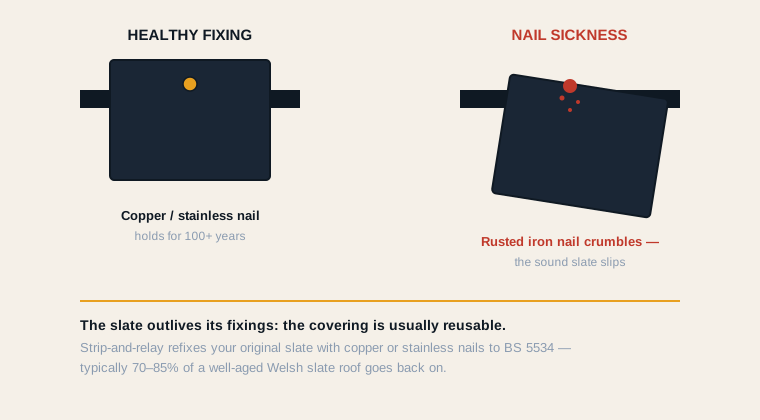
What is Nail Sickness?
Nail sickness is the progressive corrosion of the galvanised iron nails used to fix concrete and clay roof tiles on post-war properties. When these nails corrode, they lose their structural integrity and the tiles they fix become progressively loose — first moving slightly in high winds, then slipping down the roof slope over time, eventually falling off entirely. The process is slow and invisible from the ground until tiles actually move, which is why it often goes undetected until a storm event causes multiple simultaneous failures.
British Standard BS 5534 now requires mechanical fixing of every tile in many exposure zones, replacing the older practice of nailing every third or fourth tile.
Source: BS 5534
Which Norwich Properties Are Affected?
Nail sickness affects concrete interlocking tile roofs where the original galvanised iron fixings are still in place. In Norwich, this primarily means housing built between 1950 and 1985 on the large municipal and private estates. Mile Cross, Catton, Heartsease and Sprowston have extensive 1950s–1970s estate housing where nail sickness is now widespread. Newer 1980s–1990s housing on Costessey, Cringleford and Thorpe St Andrew is approaching the age range where it begins to appear. Properties with previously replaced tiles may have a mix of corroded original fixings and newer stainless fixings.
How to Identify Nail Sickness
Ground level: look for tiles that have slipped down the roof slope so that their lower edge is below the line of tiles on either side. Look for gaps where tiles have fallen. Check the ridge and hip lines for displaced tiles. Close-up: on single-storey sections or from a loft hatch, check whether tiles can be moved by hand without resistance — a well-fixed tile should be firm. Professional survey: a roofer will probe a sample of fixings with a screwdriver to check corrosion depth, check the proportion of tiles that are loose, and provide a written report on the extent of the problem.
Need a free survey or quote for your Norwich property?
Call 0160 339 6191 — Free QuoteRepair or Replace?
If the tiles themselves are in reasonable condition — not cracked, not porous, not delaminating — re-fixing with stainless steel nails is significantly cheaper than full replacement and extends the roof's life by 20–30 years. The re-fixing process involves removing each tile, replacing the corroded nail with a stainless fixing, and re-laying the tile. If tiles are brittle, porous or significantly degraded, full re-roofing is more cost-effective than re-fixing tiles that will need replacing within 5–10 years anyway. A free survey will tell you which category your roof falls into.
Costs for Norwich Nail Sickness Work
Re-fixing a full 3-bed semi roof in Norwich (stripping, replacing all fixings with stainless, replacing broken tiles, re-laying) typically costs £800–£2,000 depending on roof size and tile replacement required. This is considerably less than a full re-roof (£4,500–£7,500) and is appropriate where tiles are structurally sound. Full re-roofing on a seriously degraded concrete tile roof of the same size runs £4,500–£7,500. We provide a clear written recommendation on which approach is appropriate after the free survey.
How Nail Sickness Progresses Over Time
Nail sickness follows a predictable progression. In the early stages, tiles are firmly fixed but the nails are internally corroded — this is only detectable by probing with a screwdriver. As corrosion advances, tiles begin to move slightly in high winds — a rocking or chattering sound from the roof in storms can be an early indicator. In the intermediate stage, tiles slip downward and become visually misaligned — this is typically when homeowners first notice a problem from ground level. In the advanced stage, individual tiles fall off entirely, particularly after storm events. The time from early corrosion to tile loss can be 10–20 years, which is why many homeowners are surprised when tiles start failing on a roof that appeared sound.
Insurance and Nail Sickness — What to Know
Insurance companies sometimes dispute claims for nail sickness failures on the grounds that the condition is a pre-existing maintenance issue rather than sudden storm damage. This is technically defensible if the nail corrosion was advanced and the tiles were already loose before the storm. Documenting a history of roof surveys is the best protection against this argument. If your survey report confirms that fixings were sound at the time of inspection, a subsequent storm failure becomes much easier to claim. We note fixing condition on all survey reports specifically because of this issue.
After Re-Fixing — What to Expect
A properly executed re-fixing job with stainless nails should give 20–30 years of additional service life from tiles that are otherwise sound. The roof will feel and sound more secure in winds immediately after the work — the tile movement and vibration in storms that preceded the job should be eliminated. We recommend a survey every 5 years after re-fixing to monitor tile condition as the roof ages, since concrete tiles from the 1960s–1980s will continue to weather and may reach the end of their surface life before the new fixings fail. Re-fixing buys time; it does not make an aging concrete tile roof permanent.
Summary — What to Do Next
Nail sickness on Norwich estate housing is a predictable problem with a straightforward solution. Identified early, it is a re-fixing job that costs £800–£2,000 and extends the roof's life by 20–30 years. Identified late — when tiles are already falling and the roof needs full replacement — it costs £4,500–£7,500. The difference is a free survey. We offer free nail sickness surveys across Mile Cross, Catton, Sprowston, Costessey, Cringleford and all Norwich estate housing. The survey takes under an hour and produces a written report with a clear recommendation. Call 0160 339 6191 to arrange yours.
Last reviewed: 2026-07-20 by Norwich Roofing Experts