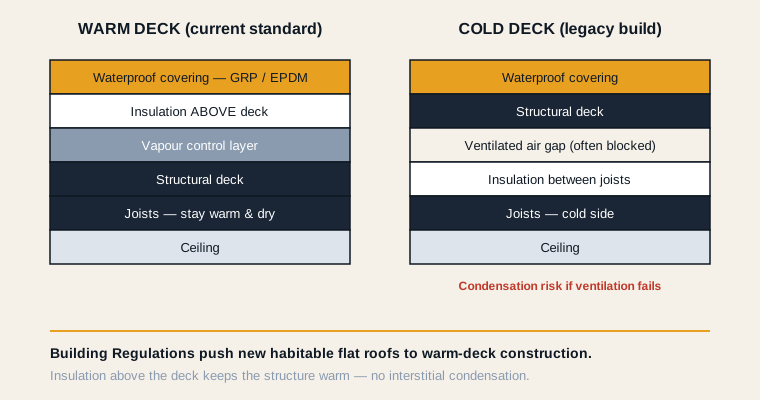
The Three Flat Roofing Systems
GRP fibreglass is a rigid, seamless system that forms a continuous monolithic deck over the roof surface. It is our recommended system for most Norwich residential flat roofs under 50m². Design life of 25+ years, minimal maintenance, tolerates foot traffic, resistant to freeze-thaw cycling. It costs slightly more than felt but the extended design life and reduced maintenance more than compensate. EPDM rubber is a single-ply membrane system better suited to larger areas over 50m², where its flexibility accommodates thermal movement across a large surface more effectively than rigid GRP. High-performance felt (torch-on or cold-applied) is a cost-effective option for budget-sensitive jobs where the roof will see minimal traffic and the deck is in good condition.
A correctly designed flat roof requires a minimum fall of 1:80 to drain fully, per British Standard BS 6229 for flat roofing.
Source: BS 6229
What Happens to Old Felt
Original 1970s and 1980s felt flat roofs degrade through a combination of UV exposure, thermal cycling and moisture ingress. The first signs are surface cracking and blistering — the felt loses its flexibility and cracks when the deck moves with temperature changes. Water then enters the cracks and saturates the underlying deck. The result is typically a wet or rotten chipboard or plywood deck that must be replaced before the new covering goes down. On most Norwich 1970s–80s flat roofs, deck replacement is needed — we always inspect and report on deck condition before quoting.
The Replacement Process
We strip the existing covering down to the deck, inspect the deck condition, and replace any wet or structurally compromised sections. New GRP or EPDM is then applied to the clean deck with correct falls to the outlet. Falls are critical — we design every installation to minimum 1:80 gradient to ensure complete drainage. Outlets are sized for the roof area and local rainfall intensity. On completion, flashings are dressed to walls and upstands, and the installation is inspected before sign-off. Most Norwich garage and extension flat roofs are completed in a single day.
Need a free survey or quote for your Norwich property?
Call 0160 339 6191 — Free QuoteCosts for Norwich Flat Roofing
GRP for a standard single garage (approximately 14–18m²): £900–£1,600. GRP for a medium extension (20–30m²): £1,800–£3,200. GRP for a larger flat roof (35–50m²): £3,000–£5,500. Deck replacement, where needed, adds £25–£45/m². EPDM on larger roofs runs approximately £60–£90/m² all-in. These prices include strip, disposal, deck inspection, falls design, outlet sizing and a 20-year material guarantee on GRP systems.
Choosing a Flat Roofing Contractor in Norwich
Ask for a written specification before any work starts — not just a price. The specification should name the system and manufacturer, state the deck preparation approach, confirm the falls design and outlet specification, and set out the guarantee terms. A contractor who won't provide this in writing is not a contractor you should use for flat roofing work. Also check that the installer is approved by the system manufacturer — GRP and EPDM systems only carry their full guarantees when installed by approved applicators.
Why GRP Outperforms Felt in Norfolk Conditions
Norfolk's climate creates specific challenges for flat roofing that make the choice of system more consequential than in milder parts of England. The combination of hard winter frosts and warm dry summers creates thermal movement stress that is greater than coastal or south-western locations. Felt flat roofs respond to this by cracking at the surface as the bitumen loses flexibility — this happens faster in Norfolk than in the south-west. GRP fibreglass is a rigid system that does not crack from thermal movement within its design parameters. It also tolerates foot traffic without damage, requires no surface maintenance for the first 10 years, and is not vulnerable to UV degradation in the way that felt is.
Finding a GRP Installer in Norwich
GRP fibreglass flat roofing requires specific application knowledge — the resin and topcoat must be mixed and applied at correct temperatures, and the glass matting must be fully wetted out without voids or dry patches. An incorrectly applied GRP system will fail early and the failures are not repairable; the whole covering must be stripped and redone. When choosing a GRP installer in Norwich, ask whether they are approved by the resin manufacturer and whether the system carries a full manufacturer guarantee as well as a workmanship guarantee. Both are required for a proper GRP installation.
What to Ask Before Signing a Flat Roofing Contract
Ask for the full specification in writing before signing anything — the system name and manufacturer, the deck preparation approach, the falls specification and outlet sizing, the guarantee terms (both manufacturer and workmanship), and the payment schedule. Ask whether the installer is manufacturer-approved for the system being fitted — GRP and EPDM systems carry their full material guarantees only when installed by approved applicators. Ask what happens if deck replacement is needed — get a per-m² rate confirmed upfront rather than finding out as a surprise on the day. Ask who will be on site — the quoted operative or a subcontractor.
Summary — What to Do Next
A properly specified and installed GRP or EPDM flat roof in Norwich will outlast the building's next significant redevelopment and require nothing more than annual outlet clearing for the first 10–15 years. The critical steps are specification (correct system, correct falls, correct outlet sizing), deck inspection and replacement where needed, and manufacturer-approved installation. We carry out free flat roofing surveys across Norwich and Norfolk, provide written specifications with every quote, and are approved installers for the GRP systems we fit. Call 0160 339 6191 to arrange a free survey.
Last reviewed: 2026-07-20 by Norwich Roofing Experts