Rubber or fibreglass? An honest, side-by-side comparison for Norwich flat roofs — lifespan, cost, finish, weather and foot traffic — with a clear steer on which suits your garage, extension or dormer.
Tell us the job in 30 seconds. No pushy sales, no call-out fee.
📞 Call Now: 0160 339 6191EPDM (rubber) lasts longer (30–50 years), flexes with the deck and installs in cooler weather; GRP (fibreglass) gives a hard, seamless, foot-trafficable finish and moulds to complex detailing but needs a dry window to cure. Choose EPDM for large simple roofs, GRP for detailed or trafficked ones.
EPDM (ethylene propylene diene monomer) is a synthetic rubber membrane, laid as a single sheet bonded to the deck — think of a large, seamless rubber blanket. GRP (glass-reinforced plastic, or fibreglass) is a liquid resin reinforced with glass matting, applied wet and cured into a hard, seamless, jointless shell. Both are modern replacements for old bitumen felt, both are used constantly on Norwich flat roofs — garages, extensions, dormers and porches — and both dramatically outlast the felt they replace. The right choice depends on the roof, the detailing, the weather window and the finish you want.
| Factor | EPDM (rubber) | GRP (fibreglass) |
|---|---|---|
| Lifespan | 30–50 years | 20–30 years |
| Finish | Flexible, matt rubber | Hard, rigid, can be top-coated any colour |
| Joints | Single sheet, few/no seams | Fully seamless, jointless shell |
| Foot traffic | Soft — light use only | Hard — tolerates regular foot traffic |
| Install weather | Tolerant, can go on cool/damp | Needs dry, mild conditions to cure |
| Flexibility | Excellent — moves with the deck | Rigid — can crack on a flexing deck |
| Complex shapes | Harder around many upstands | Excellent — moulds to any detail |
| Typical cost | Often slightly lower | Often slightly higher |
Choose EPDM when the roof is large and simple (a garage or a big rectangular extension), when the deck may flex or move, when you want the longest life, or when the weather window is tight — EPDM is more forgiving to lay in Norfolk’s changeable conditions. Choose GRP when the roof has complex detailing and many upstands, when it will see foot traffic (a balcony or a roof terrace), or when you want a hard, colour-matched, seamless finish. On a simple Cringleford kitchen extension we would often steer you to EPDM for the lifespan; on a detailed dormer or a small porch roof with lots of junctions, GRP’s mouldability wins.
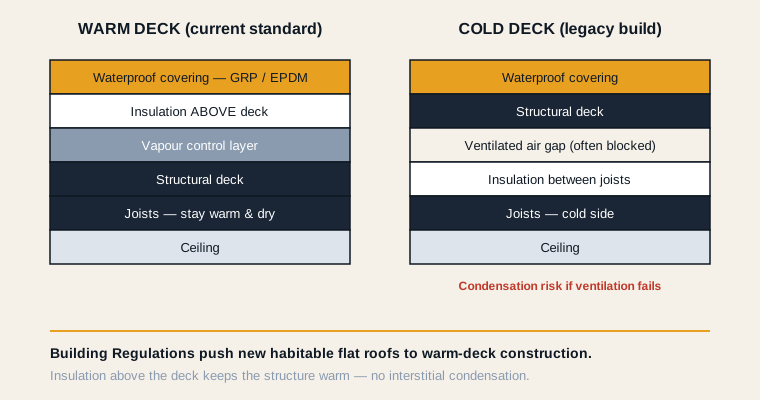
When neither is the answer: if your flat roof is leaking because of condensation rather than a covering failure, or because the deck has rotted, no new covering — EPDM or GRP — fixes that on its own. The deck and the ventilation have to be right first. We diagnose the actual cause before quoting either system.
| Roof | EPDM | GRP |
|---|---|---|
| Single garage | From £850 | From £900 |
| Medium extension | £1,700–£3,000 | £1,800–£3,200 |
| Large / complex | £2,800–£5,500 | £3,000–£6,000 |
| Warm-roof upgrade (adds) | £400–£1,200 | £400–£1,200 |
Both carry a 20-year system guarantee and a 10-year written workmanship guarantee. No deposit on small flat-roof work; nothing due before materials are on site. VAT confirmed in writing.
The installation method explains most of the practical differences. EPDM is delivered as a single large sheet, cut to fit, and bonded to the deck with adhesive; because it arrives in one piece, a typical garage or extension roof has few or no seams for water to find, and the flexible rubber tolerates the small movements a timber deck makes as it warms and cools. GRP is built up wet, on site: a base coat of resin, glass matting laid into it, then a topcoat, all cured in place into one rigid, jointless shell. That wet build is why GRP needs dry, mild conditions — rain during curing ruins it — and why a skilled installer matters so much, because the resin has to be catalysed and laid correctly. Both are craft jobs done badly by some; we lay both to manufacturer specification, which is also what keeps the system guarantee valid.
Where a flat roof leaks, it is almost never in the open field — it is at the edges, upstands, outlets and junctions. This is where the two systems diverge most. GRP’s liquid nature lets it mould seamlessly around a complicated arrangement of upstands, pipes and rooflights, forming trims and edges as one continuous piece; on a fiddly dormer or a small roof crowded with details, that is a real advantage. EPDM handles clean, simple perimeters beautifully but needs more careful detailing where many penetrations cluster, using bonded corner pieces and flashings. So the shape of your roof, not just its size, steers the choice: a big open extension favours EPDM, a small complex roof favours GRP.
Upfront cost is close, so the real economics are about lifespan and maintenance. EPDM’s 30–50-year life means that on a roof you intend to keep, it often works out cheaper per year despite the similar starting price, because you are far less likely to be re-covering inside three decades. GRP’s 20–30 years is still a huge improvement on old felt, and its hard finish shrugs off foot traffic that would mark EPDM. Neither needs much maintenance — an annual check and keeping outlets clear is enough for both. The honest summary: for a keep-it-forever roof, EPDM edges the long-run cost; for a trafficked or intricate roof, GRP earns its slightly higher price in fitness for purpose.
If you want one line to carry away: for a large, simple, keep-it-forever flat roof — a garage, a big rectangular extension — lean EPDM for its longer life and forgiving installation in Norfolk’s weather. For a small, detailed, or trafficked roof — a dormer, a porch top, a balcony, anything with lots of upstands — lean GRP for its seamless mouldability and hard finish. And whichever covering you choose, get the deck build-up right first: a warm deck under either system is what actually keeps the structure dry. If you tell us the roof, its shape and how it will be used, we will give you a straight recommendation and a written quote for the system that genuinely fits — not the one that suits us to fit. Both are excellent when specified and laid correctly; the skill is matching the system to your particular roof.
Neither is universally better — EPDM lasts longer and flexes with the deck, while GRP gives a hard, seamless, foot-trafficable finish and moulds to complex detailing. The right choice depends on the roof size, shape, use and the weather window.
EPDM typically lasts 30–50 years, GRP around 20–30 years. For pure longevity on a simple roof, EPDM usually wins.
GRP is hard and tolerates regular foot traffic, making it suitable for balconies and terraces. EPDM is softer and suits light or occasional access only.
EPDM is more forgiving to install in cool or damp conditions, so it can be an easier choice in Norfolk’s changeable weather. GRP needs a dry, mild window to cure properly.
They are broadly comparable, with GRP often slightly higher on complex roofs because of the labour to detail it. We quote both so you can compare on your specific roof.
Only if the leak is a covering failure. If it is condensation or a rotted deck, the deck and ventilation must be corrected first — a new EPDM or GRP layer alone will not solve it.
Yes — both carry a 20-year system guarantee plus our 10-year written workmanship guarantee, with the manufacturer’s materials warranty on top.
Related guides: warm vs cold deck. Ready to proceed? See flat roofing in Norwich.
Free survey, written quote and a 10-year workmanship guarantee. Call now — no call-out fee.
0160 339 6191📅 Get My Free Quote