A flat roof in Norwich costs from £900 for a standard single garage in GRP fibreglass, £1,800-3,200 for a medium extension, and £3,000-6,000 for large or complex areas. GRP and EPDM both carry 20-year
A flat roof in Norwich costs from £900 for a standard single garage in GRP fibreglass, £1,800-3,200 for a medium extension, and £3,000-6,000 for large or complex areas. GRP and EPDM both carry 20-year-plus guarantees. Free survey and deck assessment before quoting. Call 0160 339 6191.
✓NFRC Registered
✓Fully Insured £2m
✓10-Year Guarantee
✓Free Quotes
✓No Hidden Costs
Flat Roofing · Norwich
What a Flat Roof Costs in Norwich
Flat roof replacement in Norwich starts at around £900 for a standard single garage in GRP fibreglass, rises to £1,800-3,200 for a medium extension or dormer, and reaches £3,000-6,000 for large or complex flat areas. These figures include stripping the old covering, replacing the deck where needed, new insulation upgrade where appropriate, and the new waterproof system with all edge trims and detailing. The price depends heavily on deck condition and drainage design, which is why we assess the deck before quoting rather than pricing blind.
GRP Fibreglass vs EPDM Rubber
The two systems we fit in Norwich are GRP fibreglass and EPDM rubber. GRP is a seamless liquid system that cures into a rigid, walk-on surface with a crisp edge finish — ideal for visible extension roofs and areas that see foot traffic. EPDM is a single-sheet rubber membrane, fast to install with very few joints, excellent for larger simple areas. Both outlast traditional felt comfortably in Norfolk's climate and both carry 20-year-plus guarantees. We recommend the right system for your specific roof rather than fitting one system to everything.
Why Felt Fails Faster in Norfolk
Traditional built-up felt was the standard flat-roof covering on Norwich garages and extensions for decades, and it is the material we most often replace. Felt has a realistic life of 10-20 years and degrades faster under Norfolk's thermal cycling — the wide swing between cold clear nights and warm days causes the felt to expand, contract and eventually crack and blister. GRP and EPDM tolerate that cycling far better, which is why a like-for-like felt replacement is usually a false economy compared with upgrading to a modern system.
A flat roof requires a minimum fall of 1:80 to drain fully, and the deck design should follow British Standard BS 6229 for flat roofing.
— BS 6229
Local Knowledge · Norwich
The Deck and Drainage Matter More Than the Covering
The most important parts of a flat roof are the ones you cannot see: the deck and the fall. A flat roof needs a minimum 1:80 fall to drain fully, and outlets sized for the catchment area — a standard outlet is undersized for a large Norwich extension roof in our rainfall. Pre-1990 Norwich flat roofs are frequently cold, uninsulated decks that cause condensation mistaken for a covering leak. We assess deck condition, fall and drainage at survey and include any necessary correction in the quote, with the option of upgrading to a warm-roof build-up.
Insulation Upgrades and Building Regulations
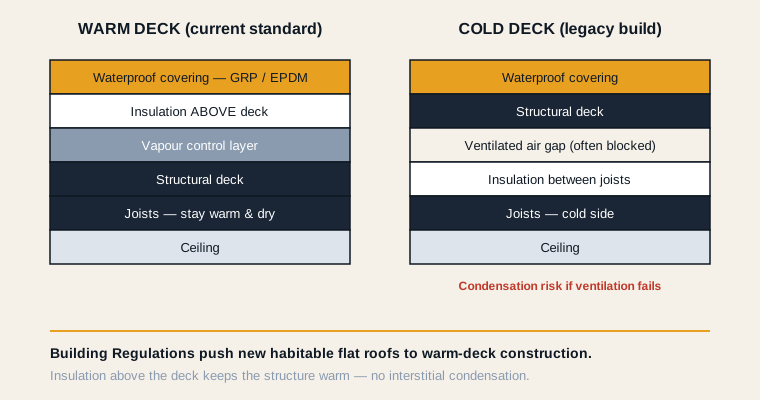
When you replace a significant area of flat roof in Norwich, Building Regulations generally require the thermal performance to be brought up to current standards — which usually means adding insulation. This is an opportunity as much as a cost: a warm-roof build-up (insulation above the deck, beneath the new covering) eliminates the condensation problems that plague older cold flat roofs and cuts heat loss. We advise on the appropriate build-up for your property and factor the regulations into the quote so there are no surprises.
Getting an Accurate Flat Roof Quote
An accurate flat-roof quote for a Norwich property states the system to be used, the deck works included, the drainage design, the insulation specification, and the guarantee. Beware quotes that price only the covering without addressing the deck or fall — those are the ones that leak within a couple of years. We provide a drawing showing the drainage design with every flat-roof quote, and we specify the system, insulation and edge detailing in writing so you can compare quotes properly.
Warm Roof vs Cold Roof — What It Means for Cost
The biggest decision on a Norwich flat roof after the covering is whether to build a warm roof or a cold roof, and it materially affects both cost and performance. A cold roof places insulation between or below the joists, is cheaper, but is prone to condensation — the hidden cause of many 'leaks' on older Norwich flat roofs. A warm roof places rigid insulation above the deck beneath the covering, eliminating the cold surface where condensation forms. It costs more upfront but performs far better and meets current Building Regulations more comfortably. On any significant flat-roof replacement we explain both options and their cost difference so you can choose with the full picture.
Flat Roof Maintenance and Getting the Full Lifespan
A modern flat roof rewards a small amount of maintenance with decades of service. GRP and EPDM systems need little, but clearing debris from the surface and outlets, checking the edge trims and upstands once a year, and dealing promptly with any ponding keeps the guarantee valid and the roof performing. The commonest cause of premature flat-roof failure in Norwich is not the covering wearing out but blocked outlets causing standing water, or foot traffic damaging a system not designed to be walked on. We advise on simple maintenance at handover, and can build a periodic check into a maintenance visit alongside your gutters.
Rooflights, Upstands and the Details That Add Cost
The flat roofs that cost more than a plain figure suggests are the ones with details, and Norwich extensions and dormers usually have them. Every rooflight or lantern needs cutting in, kerbing and flashing to stay watertight — a significant part of the labour on a modern kitchen-extension roof. Upstands where the flat roof meets a wall, parapet or the main roof need correct height and dressing to prevent water tracking behind them. Pipe penetrations, outlets and edge trims each need proper detailing. These details are exactly where cheap flat-roof jobs leak, because they are fiddly and easy to skimp. Our flat-roof quotes account for every detail on your specific roof, which is why we survey rather than quote from a photograph, and why the price reflects the real complexity of the job.
Pricing · Norwich & Norfolk
Flat Roofing Prices in Norwich
From £900
Single Garage
GRP fibreglass, standard size
£1,800-3,200
Medium Extension
GRP or EPDM, incl deck check
£3,000-6,000
Large / Complex
Multiple areas, upstands, rooflights
20yr+
Guarantee
GRP and EPDM systems
Free survey and written quote — no call-out fee, no obligation
Flat roofs fail differently from pitched ones — often the "leak" is condensation, not a hole. The first job is diagnosing whether you need a re-cover, a deck repair, or just better drainage and ventilation.
Ponding water that never drains off the roof
Blistering, cracking or splitting in an old felt covering
Damp appearing on the ceiling below in cold weather (condensation)
The covering is past 15–20 years (typical felt life)
Soft or springy areas underfoot indicating deck decay
When it is not the answer: If a sound GRP or EPDM roof has a single failed detail, a targeted repair beats a full re-cover — and if the "leak" is condensation, a new covering alone will not fix it. Read the full guide.
Warm deck versus cold deck flat-roof build-ups compared.The process
From First Call to Sign-Off
1. Survey & deck assessment
We check the deck, falls, drainage and for condensation or insulation issues — the causes of most flat-roof failures.
2. Specification quote
You receive a written quote naming the system (GRP or EPDM), deck works, insulation upgrade and a drainage drawing.
3. Scheduling
We book a dry-weather window suited to the system, since liquid systems need dry conditions to cure.
4. Installation
We strip the old covering, repair or replace the deck, upgrade insulation to a warm-roof build-up where appropriate, and fit the new system.
5. Handover & sign-off
We complete with correct falls and edge trims, test drainage, and hand over the 20-year system guarantee.
Timescales
Typical Timescales
Job
Typical duration
Single garage roof (GRP)
1–2 days
Medium extension roof
2–4 days
Large or complex flat roof
4–7 days
Deck replacement (adds)
1–2 days
GRP and liquid systems need dry conditions to cure — we schedule around the forecast and never lay in the wet.
Access
Getting Safely onto Norwich Roofs
Most flat roofs are low-level and worked from a tower or ladder; scaffold is needed only where the flat roof is at height or edge protection is required. Scaffold is specified for: first-floor and higher flat roofs, or where edge-protection regulations require it - always itemised in your written quote, never a hidden extra, and we arrange it.
Norwich’s medieval core and Golden Triangle terraces mean tight street frontages, rear-access-only roofs and permit-controlled pavement space for scaffold. Pavement scaffold and skip permits go through Norwich City Council; allow a few working days on streets like Elm Hill, Magdalen Street, Gentleman’s Walk where space is tight.
Pricing
Flat Roofing Prices in Norwich
Job
Typical range
Notes
GRP garage roof
From £900
Standard single garage
EPDM garage roof
From £850
Single-sheet rubber
Flat extension roof (medium)
£1,800–£3,200
GRP or EPDM, incl. deck check
Large / complex flat roof
£3,000–£6,000
Multiple areas, upstands
Warm-roof insulation upgrade (adds)
£400–£1,200
To meet Building Regs
What moves the price
System choice (GRP, EPDM or liquid)
Deck condition and whether it needs replacing
Insulation upgrade to meet Building Regulations
Number of upstands, outlets and rooflights to detail
Worked example: A GRP re-cover on a Cringleford kitchen extension with a warm-roof upgrade and new outlet: around £2,900 including deck repair.
No deposit on small flat-roof repairs. Staged payments on larger work — nothing before materials are on site. VAT status confirmed in writing.
GRP and EPDM installations carry a 20-year system guarantee; workmanship is covered for 10 years in writing alongside the manufacturer’s materials warranty.
Covered: workmanship for 10 years, in writing, transferable if you sell.
On top: manufacturer warranties on materials (terms vary by product).
Not covered: storm or impact damage - that is an insurance matter, and we will document it for your claim.
If a fault appears in covered work, we come back and put it right. No quibbling, no re-charge.
A flat roof requires a minimum fall of 1:80 to drain fully, with the deck design following British Standard BS 6229 for flat roofing.
— BS 6229
Good to know
Disruption, Mess & Weather
Low-disruption for a garage or extension — a day or two of work, minimal noise, and no need to be home for external work. We clear all old felt and debris. You do not need to stay home for external work - we just need power and access agreed in advance.
Flat roofing needs dry weather to cure properly; Norfolk’s changeable conditions mean we watch the forecast and keep the deck covered between sessions. Norfolk’s exposure to north-easterly gales off the North Sea, and Wensum valley humidity, drive wind-lifted tiles and slower autumn drying.
"Replaced the felt on our extension with GRP after years of patching. They found the deck was soft in one corner and sorted it. Two winters on, bone dry."
Philip B.Cringleford, NR4
★★★★★
"EPDM on the garage roof. Quick, tidy, and they explained why rubber suited that roof better than fibreglass. Fair price and a proper guarantee."
Angela W.Old Catton, NR6
★★★★★
"Our flat roof kept 'leaking' — turned out to be condensation from no insulation. They fitted a warm roof build-up and the problem's gone completely."
Roy C.Mile Cross, NR3
FAQs · Norwich
Flat Roofing Norwich — Common Questions
A standard single garage in GRP fibreglass starts from £900, a medium extension £1,800-3,200, and large or complex areas £3,000-6,000. Prices include deck assessment and a 20-year-plus guarantee. Free survey before quoting.
GRP fibreglass suits visible and walk-on areas with a crisp finish; EPDM rubber suits larger simple areas with few joints. Both outlast felt and carry 20-year guarantees. We recommend the right system for your specific roof.
Felt lasts only 10-20 years and degrades faster under Norfolk's thermal cycling, cracking and blistering as it expands and contracts. GRP and EPDM tolerate that cycling far better, so a modern replacement is usually better value than like-for-like felt.
When replacing a significant flat-roof area, Building Regulations generally require thermal performance to meet current standards, usually meaning added insulation. A warm-roof build-up also eliminates the condensation common on older cold flat roofs.
A flat roof needs a minimum 1:80 fall and correctly sized outlets to drain fully. Standing water from poor falls degrades any covering. We assess and correct falls at survey and provide a drainage drawing with every quote.
GRP fibreglass and EPDM both last 25 years or more with a 20-year guarantee, against 10-20 years for traditional felt. Actual life depends on deck condition, drainage and installation quality.
We can, but only after assessing the deck and fall. Pricing the covering alone without addressing a failing deck or poor drainage is why many flat roofs leak within two years. We include necessary deck and drainage works in the quote.
Yes — the survey, deck assessment and written quote are free with no obligation. We provide a drainage drawing and full specification so you can compare quotes properly. Call 0160 339 6191.