Flat-roofed extensions, garages and outbuildings are common across Mile Cross. Most of the 1970s-1990s felt on these structures is now at or past the end of its serviceable life. We install GRP fibreglass and EPDM systems with a 20-year material guarantee. Free survey, written quote.
Mile Cross is one of Norwich's largest post-war council estates, built predominantly in the 1950s-1960s. Concrete interlocking tile on standard semi-detached and terraced housing is universal. The north Norwich elevation gives more wind exposure than sheltered south or west city locations.
GRP fibreglass and EPDM rubber flat roofing on Mile Cross extensions, garages and outbuildings. Full strip and deck inspection, deck replacement where needed, correct falls design, outlet sizing, and 20-year material guarantee. No hidden deck replacement costs — we include them in the quote after survey.
Mile Cross's 1950s-1970s municipal estate housing means flat-roofed additions are common. Nail sickness on 1960s concrete tile stock is the defining structural roofing issue on Mile Cross. North-facing ridge lines lose mortar pointing faster than equivalent south-facing roofs because of moisture retention. Ridge cap displacement after storm events is the most common emergency call from this area. GRP is our recommended system for most residential flat roofs — it tolerates Norfolk's thermal cycling better than felt and requires no maintenance for the first 10 years.
The most common mistake in flat roofing is putting a new covering over a wet or compromised deck. Original 1970s-80s chipboard decks on Mile Cross properties are frequently saturated by the time the covering visibly fails — water has been entering slowly for years. We inspect every deck before quoting and include replacement in the quote where needed. A new GRP roof over a compromised deck will fail early regardless of system quality.
A roofer who works in Mile Cross regularly knows the housing stock, the tile profiles in common use, the access challenges on local streets, and the planning constraints that apply in the area. We cover Mile Cross as part of our regular Norwich patch — not as an out-of-area job that attracts a premium. Call 0160 339 6191 for a free survey, typically available within the week.
Across Mile Cross, most flat roofs are on rear extensions, garages and dormers rather than main roofs, so the work is usually low-level and quick — but Mile Cross’s specific exposure still dictates the falls and drainage detail we design in.
Standard garage (14-18m2) from £900-1,600 GRP. Medium extension (20-30m2) from £1,800-3,200. Deck replacement where needed at £25-45/m2. Written itemised quote after free survey. Nail sickness re-fixing on a Mile Cross 3-bed semi costs £800-1,800 depending on the proportion of tiles needing replacement alongside the re-fixing.
Mile Cross is one of Norwich’s early planned council estates, north of the city centre off the Aylsham Road. The first thing to establish is whether you are looking at an isolated repair or the early signs of a roof past its serviceable life.
When it is not the answer: If a sound GRP or EPDM roof has a single failed detail, a targeted repair beats a full re-cover — and if the "leak" is condensation, a new covering alone will not fix it. Read the full guide.
On a Mile Cross flat roof we check the deck, falls and ventilation first, because after a century of norfolk weather, mile cross roofs are prime nail-sickness territory, with widespread slipped tiles, tired ridge mortar and original perished underlay. — and the “leak” is often condensation, not a hole. Mile Cross is one of Norwich’s early planned council estates, north of the city centre off the Aylsham Road.
Every Mile Cross job starts with a genuine inspection — roof surface and loft, not a ground-level glance — so we diagnose what has actually failed rather than guessing from a photo.
We put the quote in writing and break it down line by line — materials, access, scaffold if needed, and guarantee — so you can see exactly what you are paying for.
With the quote agreed, we schedule the work around your diary and the forecast, confirming scaffold, skip and permit arrangements for your Mile Cross street beforehand.
On the day we carry out the work with matched materials, keeping your Mile Cross roof weathertight at every stage.
At the end we clear every scrap of debris, walk you through what we did, and hand over the written 10-year workmanship guarantee.
| Job | Typical duration |
|---|---|
| Single garage roof (GRP) | 1–2 days |
| Medium extension roof | 2–4 days |
| Large or complex flat roof | 4–7 days |
| Deck replacement (adds) | 1–2 days |
Work at height on Mile Cross properties pauses in heavy rain or wind — we plan for it, and keep everything weathertight between sessions.
Mile Cross estate housing generally allows side or rear scaffold access, though some tight terraced runs need on-street standing and a Norwich City Council permit; setup is usually manageable. Most Mile Cross flat roofs are low-level and worked from a tower; only first-floor and higher flat roofs need scaffold.
A flat roof on a 1930s council-built terrace off Suckling Avenue in Mile Cross: we survey, quote in writing and carry out the work to the standard the Mile Cross roof needs, with the access this street requires itemised separately.
| Job | Typical range | Notes |
|---|---|---|
| GRP garage roof | From £900 | Standard single garage |
| EPDM garage roof | From £850 | Single-sheet rubber |
| Flat extension roof (medium) | £1,800–£3,200 | GRP or EPDM, incl. deck check |
| Large / complex flat roof | £3,000–£6,000 | Multiple areas, upstands |
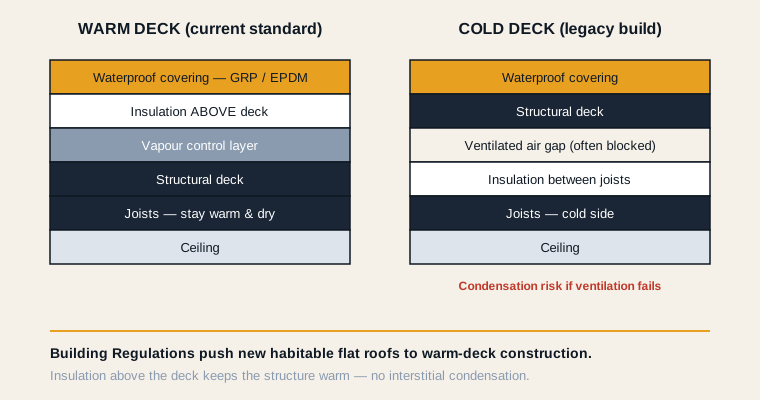
| Warm-roof insulation upgrade (adds) | £400–£1,200 | To meet Building Regs |
No deposit on small flat-roof repairs. Staged payments on larger work — nothing before materials are on site. VAT status confirmed in writing.
Covering NR3 and surrounding postcodes.
You get a written, transferable 10-year workmanship guarantee on any Mile Cross job, alongside the manufacturer warranties on the materials we fit. The estate’s uniform interwar terraces around Mile Cross Road show the same age-related wear street by street.
A flat roof requires a minimum fall of 1:80 to drain fully, with the deck design following British Standard BS 6229 for flat roofing.
— BS 6229
Low-disruption for a garage or extension — a day or two of work, minimal noise, and no need to be home for external work. We clear all old felt and debris. You do not need to stay home for external work - we just need power and access agreed in advance.
Flat roofing needs dry weather to cure properly; Norfolk’s changeable conditions mean we watch the forecast and keep the deck covered between sessions. The estate’s ageing concrete and clay tile roofs are prime nail-sickness territory after decades of Norfolk weather.
“GRP on the kitchen extension in Mile Cross. Deck inspection found wet chipboard — included in the quote, no surprises.”
“GRP on the garage in Mile Cross. Deck inspection found wet chipboard — included in the quote, no surprises.”
“GRP on the rear extension in Mile Cross. Deck inspection found wet chipboard — included in the quote, no surprises.”
Flat-roofed rear extensions were added to a large proportion of Mile Cross's estate housing in the 1970s-1990s. Most of these are now at end of first or second felt life. GRP fibreglass is our recommended replacement system — it performs well in Mile Cross's north Norwich exposure and requires no maintenance for 10+ years post-installation. We include deck inspection and replacement in all flat roof quotes for properties of this age.
A standard garage costs £900-1,600 for GRP. Medium extensions run £1,800-3,200. Deck replacement where needed adds £25-45/m2. Written itemised quote after free survey. In Mile Cross specifically, after a century of Norfolk weather, Mile Cross roofs are prime nail-sickness territory, with widespread slipped tiles, tired ridge mortar and original perished underlay.
GRP has a design life of 25+ years and carries a 20-year material guarantee when installed by an approved applicator. In Norfolk's climate GRP significantly outperforms felt because it does not crack from thermal movement.
Sometimes — isolated blisters or cracks on a felt roof can be repaired if the deck is sound. If the covering is cracked throughout, the deck is wet, or the roof has been repaired multiple times, replacement is more cost-effective. We assess this at survey. The estate’s ageing concrete and clay tile roofs have taken decades of Norfolk wind and rain, which is why age-related failure is so widespread here.
Most Mile Cross garage and extension flat roofs are completed in a single day. Larger roofs or those requiring significant deck replacement may take 2 days.
Re-roofing an existing flat roof is permitted development in most cases. New flat-roofed extensions may require permission depending on size and location. We confirm the planning position as part of every free survey. In Mile Cross specifically, after a century of Norfolk weather, Mile Cross roofs are prime nail-sickness territory, with widespread slipped tiles, tired ridge mortar and original perished underlay.
Nail sickness is the progressive corrosion of the iron nails that fix concrete roof tiles on post-war properties. On Mile Cross housing built before 1980, there is a high probability that nail corrosion is present to some degree. We offer free nail sickness surveys across Mile Cross — the process takes under an hour and produces a written report.
Re-fixing a standard 3-bed semi on Mile Cross with stainless steel nails typically costs £800-2,000 depending on the proportion of tiles requiring replacement and roof size. This is significantly less than full re-roofing and extends the roof's service life by 20-30 years on tiles that are otherwise sound. In Mile Cross specifically, after a century of Norfolk weather, Mile Cross roofs are prime nail-sickness territory, with widespread slipped tiles, tired ridge mortar and original perished underlay.
Annual outlet clearing is the primary maintenance requirement — debris accumulation blocks outlets and causes ponding. Beyond that, visual inspection every 2-3 years to check that edge flashings remain well-bonded and that no surface damage has occurred from foot traffic or impact. GRP does not require re-coating or surface treatment within its 25-year design life under normal conditions.
GRP fibreglass is a rigid system that forms a continuous monolithic deck — best for roofs under 50m2 where rigidity is an advantage. EPDM rubber is a flexible single-ply membrane better suited to larger areas where thermal movement across the surface is greater. Both carry 20-year material guarantees. We advise on the most appropriate system for each specific installation. The estate’s uniform interwar terraces around Mile Cross Road show the same age-related wear street by street.
In most cases, no — we strip the existing covering to inspect the deck before installing the new system. Installing new covering over existing felt conceals deck condition and voids the material guarantee. The one exception is GRP over a sound existing deck where the existing covering is stripped but the deck is confirmed sound on inspection.
No call-out fees. No obligation. Local Norwich roofers who know Mile Cross properties.
0160 339 6191 ✉ Email Us