A full re-roof on a Mile Cross property is a 30-60 year decision. We survey the roof structure before quoting, specify materials correctly for the property age and location, and provide a written guarantee on all work. Free survey, no obligation.
Mile Cross is one of Norwich's largest post-war council estates, built predominantly in the 1950s-1960s. Concrete interlocking tile on standard semi-detached and terraced housing is universal. The north Norwich elevation gives more wind exposure than sheltered south or west city locations.
Full roof replacement on Mile Cross properties including survey, structural inspection, material specification, scaffold, strip and disposal, new breathable membrane, new battens, new tile or slate, dry-fix ridge where appropriate, and all associated leadwork. Written 10-year guarantee on all re-roofing work.
We survey from the roof surface, not just from the ground. On Mile Cross's 1950s-1970s municipal estate housing we specifically check rafter and wall plate condition, existing underlay integrity, valley and hip construction, chimney stack condition, and fascia board soundness before quoting. Structural issues found at survey are included in the quote — not added on the day.
The correct material for a Mile Cross re-roof depends on the property's age, original roofing, and planning status. We advise on the right specification as part of every survey at no charge. On period properties we always recommend like-for-like — the visual and planning case for matching original clay pantile or Welsh slate is strong, and the long-term cost difference is smaller than homeowners expect.
A roofer who works in Mile Cross regularly knows the housing stock, the tile profiles in common use, the access challenges on local streets, and the planning constraints that apply in the area. We cover Mile Cross as part of our regular Norwich patch — not as an out-of-area job that attracts a premium. Call 0160 339 6191 for a free survey, typically available within the week.
A re-roof in Mile Cross is planned around the area’s specific stock and access — what suits a Mile Cross roof is rarely what suits the next neighbourhood, so we spec each job to the property in front of us.
3-bed semi re-roof from £4,500 (concrete tile) to £9,000 (clay pantile). Larger detached properties from £7,000-15,000. Written itemised quote after free survey specifying all materials by name. Nail sickness re-fixing on a Mile Cross 3-bed semi costs £800-1,800 depending on the proportion of tiles needing replacement alongside the re-fixing.
Mile Cross is one of Norwich’s early planned council estates, north of the city centre off the Aylsham Road. The first thing to establish is whether you are looking at an isolated repair or the early signs of a roof past its serviceable life.
When it is not the answer: If the covering is sound and only a few tiles or one detail have failed, a targeted repair is the right call — replacing a serviceable roof is oversell. Read the full guide.
A Mile Cross re-roof begins with a full timber inspection — on older Mile Cross stock the rafter feet and wall plates matter as much as the covering — because after a century of norfolk weather, mile cross roofs are prime nail-sickness territory, with widespread slipped tiles, tired ridge mortar and original perished underlay. Mile Cross is one of Norwich’s early planned council estates, north of the city centre off the Aylsham Road.
Every Mile Cross job starts with a genuine inspection — roof surface and loft, not a ground-level glance — so we diagnose what has actually failed rather than guessing from a photo.
We put the quote in writing and break it down line by line — materials, access, scaffold if needed, and guarantee — so you can see exactly what you are paying for.
With the quote agreed, we schedule the work around your diary and the forecast, confirming scaffold, skip and permit arrangements for your Mile Cross street beforehand.
On the day we carry out the work with matched materials, keeping your Mile Cross roof weathertight at every stage.
At the end we clear every scrap of debris, walk you through what we did, and hand over the written 10-year workmanship guarantee.
| Job | Typical duration |
|---|---|
| 3-bed semi, concrete tile | 3–5 days |
| 3-bed semi, clay pantile | 4–7 days |
| Larger detached / complex roof | 5–8 days |
| Scaffold up for | 5–10 days total |
Work at height on Mile Cross properties pauses in heavy rain or wind — we plan for it, and keep everything weathertight between sessions.
Mile Cross estate housing generally allows side or rear scaffold access, though some tight terraced runs need on-street standing and a Norwich City Council permit; setup is usually manageable. A full Mile Cross re-roof always needs perimeter scaffold, itemised as a fixed line in the quote.
A re-roof on a 1930s council-built terrace off Suckling Avenue in Mile Cross: we survey, quote in writing and carry out the work to the standard the Mile Cross roof needs, with the access this street requires itemised separately.
| Job | Typical range | Notes |
|---|---|---|
| Concrete tile re-roof, 3-bed semi | £6,500–£11,500 | Supplied & fitted, incl. scaffold |
| Clay pantile re-roof, 3-bed semi | £9,500–£15,500 | Traditional Norwich material |
| Welsh slate re-roof, 3-bed semi | £11,000–£18,500 | Period & Edwardian stock |
| Per square metre (installed) | £85–£280/m² | By material |
| Chimney re-flash (per stack, adds) | £250–£600 | Most period homes need it |
Staged payments on re-roofs — nothing up front before materials are on site. Re-roofing an existing home usually qualifies for reduced-rate VAT, confirmed in writing before work begins.
Covering NR3 and surrounding postcodes.
You get a written, transferable 10-year workmanship guarantee on any Mile Cross job, alongside the manufacturer warranties on the materials we fit. The estate’s uniform interwar terraces around Mile Cross Road show the same age-related wear street by street.
Re-roofing an existing residential property usually qualifies for a reduced 5% VAT rate rather than the standard 20%, subject to HMRC conditions.
— HMRC VAT Notice 708
A re-roof is the most disruptive job we do — scaffold up for a week or more, noise during strip-off, and a skip on site. We protect planting and paths and agree everything in advance. You do not need to stay home for external work - we just need power and access agreed in advance.
Re-roofing runs spring through autumn ideally; we keep the roof weathertight each night and pause tiling in high wind or heavy rain. The estate’s ageing concrete and clay tile roofs are prime nail-sickness territory after decades of Norfolk weather.
“Full re-roof on our 1930s semi property in Mile Cross. Survey was thorough — found structural issues we didn't know about. All fixed and included in the original quote.”
“Full re-roof on our Victorian terrace property in Mile Cross. Survey was thorough — found structural issues we didn't know about. All fixed and included in the original quote.”
“Full re-roof on our 1970s detached property in Mile Cross. Survey was thorough — found structural issues we didn't know about. All fixed and included in the original quote.”
Mile Cross's 1950s-1970s semi-detached and terraced housing represents a straightforward re-roofing proposition — standard pitched roofs, concrete interlocking tile, accessible for scaffold. Most properties in this era have a main dwelling roof that has never been re-roofed and is approaching or past design life. We carry out free surveys on all Mile Cross properties and include a dry-fix ridge system specification as standard on all re-roofing quotes — the north Norwich exposure makes dry-fix essential rather than optional.
Mile Cross is one of Norwich's most substantial post-war residential areas, and the roofing maintenance cycle on its 1950s-1970s housing stock is now well established. Nail sickness surveys, ridge repointing, flat roof replacement on extensions — these are the routine work cycles that properties in this area are going through. We are familiar with the housing stock, the access constraints of the estate layout, and the specific failure patterns that arise on north Norwich plateau properties of this age.
A standard 3-bed semi costs £4,500-7,500 for concrete tile or £7,000-12,000 for clay pantile. Larger properties or complex roof plans add to this. Full itemised quote after free survey. In Mile Cross specifically, after a century of Norfolk weather, Mile Cross roofs are prime nail-sickness territory, with widespread slipped tiles, tired ridge mortar and original perished underlay.
A standard 3-bed semi takes 3-5 days. Period properties with pantile sourcing take 4-7 days. Larger detached properties allow 5-8 days. Scaffold is typically up for 5-10 days total.
Yes — we work section by section maintaining a weathertight cover throughout. The vast majority of Mile Cross re-roofs are carried out with residents in occupation. The estate’s ageing concrete and clay tile roofs have taken decades of Norfolk wind and rain, which is why age-related failure is so widespread here.
Written 10-year workmanship guarantee on all re-roofing. Material guarantees vary by product — dry-fix ridge systems carry a 40-year manufacturer guarantee. Full documentation provided on completion.
Like-for-like replacement using the same material type does not usually require planning permission. Changing from clay to concrete on a conservation area property does require consent. We check the planning position as part of every survey. In Mile Cross specifically, after a century of Norfolk weather, Mile Cross roofs are prime nail-sickness territory, with widespread slipped tiles, tired ridge mortar and original perished underlay.
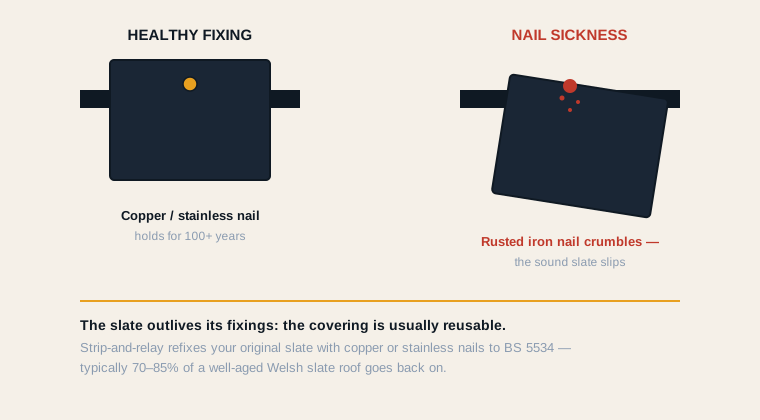
Nail sickness is the progressive corrosion of the iron nails that fix concrete roof tiles on post-war properties. On Mile Cross housing built before 1980, there is a high probability that nail corrosion is present to some degree. We offer free nail sickness surveys across Mile Cross — the process takes under an hour and produces a written report.
Re-fixing a standard 3-bed semi on Mile Cross with stainless steel nails typically costs £800-2,000 depending on the proportion of tiles requiring replacement and roof size. This is significantly less than full re-roofing and extends the roof's service life by 20-30 years on tiles that are otherwise sound. In Mile Cross specifically, after a century of Norfolk weather, Mile Cross roofs are prime nail-sickness territory, with widespread slipped tiles, tired ridge mortar and original perished underlay.
April through September is optimal — longest dry windows, warmest temperatures for lead and mortar work, longest daylight hours for scaffold safety. That said, we carry out re-roofs throughout the year. Winter work is possible but weather delays are more likely, particularly for lead work which requires dry conditions. We schedule accordingly and give realistic timelines.
Yes — a recently re-roofed property with documentation sells more easily and at a stronger price than an equivalent property with an aging roof that a buyer knows needs attention. Estate agents consistently cite roof condition as one of the top factors affecting buyer confidence on period properties. The value uplift on a well-documented re-roof typically exceeds the cost on period Norwich housing. The estate’s uniform interwar terraces around Mile Cross Road show the same age-related wear street by street.
Check NFRC registration at nfrc.co.uk using the contractor name. Ask for their public liability insurance certificate — minimum £2m. Check they have a physical address and a landline number. Ask for references from recent local jobs. Get the quote in writing with materials specified by name. A contractor who resists any of these checks should not be carrying out a re-roof on your property.
No call-out fees. No obligation. Local Norwich roofers who know Mile Cross properties.
0160 339 6191 ✉ Email Us