Welsh slate is the second most important roofing material in historic Norwich after clay pantile. Edwardian and late-Victorian professional housing across Eaton, the Golden Triangle and the inner suburbs used Welsh slate as a prestige alternative to pantile — and much of it is still in place. Matching, repairing and re-roofing slate correctly requires specific knowledge and sourcing that most Norwich roofers do not have. We work with Welsh slate regularly. Free survey, no call-out fee.
Natural Welsh slate arrived in Norwich through the Victorian rail network, replacing more expensive local materials on higher-status housing from the 1860s onwards. The dominant profiles are Bangor Blue — a consistent blue-grey slate — and Ffestiniog — slightly thicker, with more colour variation. The professional housing of Eaton, the large semis of Unthank Road, and the detached properties around Newmarket Road all make significant use of Welsh slate. At 100-150 years old, most original Norfolk Welsh slate is approaching or past the design life of the original copper or iron fixing nails, though the slate itself is often structurally sound.
For listed buildings and conservation areas, see our heritage roofing page.
Matching slate for a repair requires assessing the existing tile's thickness, origin, colour, and surface texture. Welsh slate from different quarries and periods varies considerably — Bangor Blue and Ffestiniog are different products, and even within each quarry there is variation between extraction periods. A mismatched slate repair on a Norwich period property is immediately visible from street level and will remain visible for the life of the roof. We hold stock of the most common Norwich Welsh slate profiles and have sourcing relationships for harder-to-match examples.
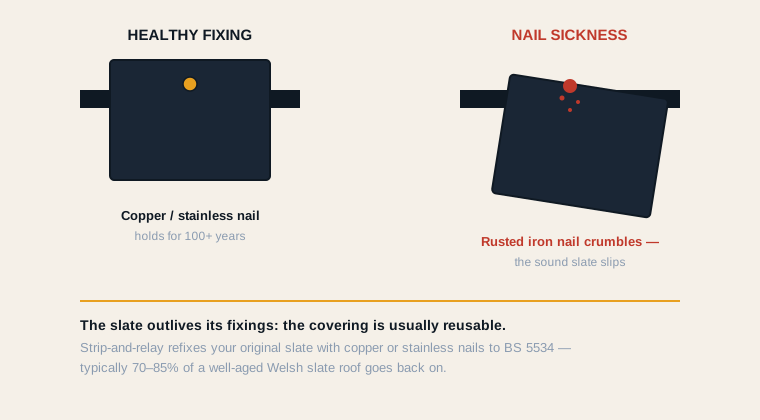
As with clay pantile, the most common structural issue on Welsh slate roofs is nail sickness — corrosion of the original copper or iron fixing nails. Copper nails corrode more slowly than iron but both eventually fail, causing slates to slip progressively until a storm event causes multiple failures simultaneously. Re-fixing with new stainless nails (for slates that are otherwise sound) is significantly cheaper than full re-roofing and extends the roof life by 20-30 years. We offer free nail sickness surveys on all Norwich properties with original Welsh slate.
A full slate re-roof uses either new natural Welsh slate (currently sourced primarily from Ffestiniog and Penrhyn quarries) or reclaimed Welsh slate from demolished buildings. Reclaimed slate is appropriate for conservation area properties where matching existing colour and texture is important — it weathers to the same tones as the adjacent surviving slates. New quarried slate has a slightly different initial appearance that weathers to match over 5-10 years. We advise on the right approach for each property based on conservation requirements and budget.
On conservation area properties in Norwich, replacing Welsh slate with concrete or fibre cement alternatives requires planning consent and is unlikely to be approved. Like-for-like natural slate replacement does not require consent in most cases. On listed buildings, all roofing work requires listed building consent regardless of material — we advise on the consent process and typical timescales during the survey.
Single slate replacement from £80-180 including matching and sourcing. Nail sickness re-fixing on a standard semi from £900-2,200. Full Welsh slate re-roof from £6,500-12,000 depending on property size and slate specification. Free survey and written quote.
0160 339 6191 — Free survey, no call-out fee.
Welsh slate roofs the Victorian and Edwardian half of Norwich, and the slate usually outlives its fixings. The question is whether you need re-fixing and matching, or a full strip-and-relay.
When it is not the answer: Because sound Welsh slate is reusable, a full new-slate roof is rarely needed — strip-and-relay refixes 70–85% of the original slate. Buying all-new slate when the old is good is oversell. Read the full guide.
We check the slate condition, the fixings, and whether the slate is reusable — usually it is.
You get an itemised quote for re-fixing, matching or strip-and-relay, with the slate source and lead detailing specified.
We book the work, sourcing matched reclaimed slate where individual replacements are needed.
We strip and relay, refixing sound slate with copper or stainless nails to BS 5534 and replacing only the broken slates.
We complete to a consistent, weathertight finish with sound lead detailing and hand over the guarantee.
| Job | Typical duration |
|---|---|
| Re-fix slipped slates | Half a day to a day |
| Lead valley re-line between slopes | 1–2 days |
| Full strip & relay, semi | 5–8 days |
| Matched slate sourcing (lead time) | 1–2 weeks |
Sourcing matched reclaimed Welsh slate can add lead time; we confirm before booking.
Slate work needs full scaffold for safe handling and standing time on the steeper pitches typical of Victorian roofs. Scaffold is specified for: strip-and-relay, valley work, and any slate job beyond a few isolated slates - always itemised in your written quote, never a hidden extra, and we arrange it.
Norwich’s medieval core and Golden Triangle terraces mean tight street frontages, rear-access-only roofs and permit-controlled pavement space for scaffold. Pavement scaffold and skip permits go through Norwich City Council; allow a few working days on streets like Elm Hill, Magdalen Street, Gentleman’s Walk where space is tight.
| Job | Typical range | Notes |
|---|---|---|
| Re-fix slipped slates | £150–£400 | Reusing sound slate |
| Lead valley re-line | £400–£900 | Between slate slopes |
| Welsh slate per m² (installed) | £140–£280/m² | Supplied & fitted |
| Full strip & relay, semi | £11,000–£18,500 | Refixing 70–85% original slate |
| Matched reclaimed slate sourcing | Per spec | Quarry & thickness matched |
Worked example: A strip-and-relay on a Golden Triangle Victorian terrace refixing original slate to BS 5534 with new lead valleys: around £260/m² including scaffold.
No deposit on isolated slate repairs. Staged payments on strip-and-relay — nothing before materials on site. Reduced-rate VAT on qualifying re-roofs, confirmed in writing.
Covering NR1, NR2, NR3, NR4, NR5, NR6, NR7 and surrounding postcodes.
Workmanship carries a 10-year written guarantee; strip-and-relay refixes your original slate to BS 5534 with new copper or stainless fixings.
If a fault appears in covered work, we come back and put it right. No quibbling, no re-charge.
Since the 2018 revision of BS 5534, slates and tiles must be mechanically fixed; strip-and-relay refixes sound slate with new copper or stainless nails.
— BS 5534 (2018)
Full scaffold and some noise during strip work. We protect the property and planting, and reuse your original slate wherever sound — less waste, better match. You do not need to stay home for external work - we just need power and access agreed in advance.
Slate work runs spring through autumn; we keep the roof weathertight overnight and avoid handling slate in frost. Norfolk’s exposure to north-easterly gales off the North Sea, and Wensum valley humidity, drive wind-lifted tiles and slower autumn drying.
Weighing your options? See natural vs synthetic slate.
“Re-fixed the Welsh slate on our Edwardian semi — original copper nails had corroded on about 40% of the roof. Correctly assessed, stainless re-fixed throughout, two replaced slates matched exactly.”
“Six slates replaced on the Victorian terrace. Matched Bangor Blue from their stock — impossible to tell which slates are new from the street.”
“Full Welsh slate re-roof on the 1900s detached. Reclaimed slate sourced to match the surviving tiles on the garage. Conservation area compliance confirmed before start.”
Single slate replacement costs £80-180 including sourcing matched tile. Minor repairs covering 5-20 slates run £250-600. Nail sickness re-fixing on a full 3-bed semi costs £900-2,200. Full Welsh slate re-roof from £6,500-12,000. Free survey and written quote.
Yes — matching Welsh slate is a core part of our service. We assess the existing slate by thickness, quarry origin and colour before every repair and confirm sourcing before quoting. We do not carry out slate repairs using concrete or fibre cement alternatives on period properties.
Natural Welsh slate correctly fixed lasts 80-150 years. The slate itself rarely fails — it is the fixing nails that corrode. A well-maintained Welsh slate roof with stainless fixings should outlast any concrete or fibre cement alternative by decades.
Almost certainly corroded fixing nails — nail sickness. On pre-1960 Norwich properties with original copper or iron fixings, progressive corrosion causes slates to lose their grip. Re-fixing with stainless nails on sound slates is significantly cheaper than re-roofing and extends the roof life by 20-30 years.
Like-for-like natural Welsh slate replacement does not require planning permission on most Norwich properties. Changing from slate to a concrete or fibre cement alternative on a conservation area property does require consent. We check planning status on every survey.
Reclaimed slate is salvaged from demolished buildings — it matches the weathered appearance of existing adjacent slates immediately. New quarried slate has a slightly fresher appearance that weathers to match over 5-10 years. For conservation area repairs requiring close visual matching, reclaimed is preferable. For full re-roofs where appearance will unify over time, new quarried is appropriate.
Welsh slate is a consistent blue-grey colour, slightly rough to the touch, and rings clearly when tapped. Fibre cement slate is heavier, slightly less uniform in colour, and has a duller sound when tapped. Concrete tile is heavier still and typically darker. We identify slate type during the survey.
Yes — Norwich has some properties where different roof planes use different materials, or where previous repairs have introduced different tiles. We assess each plane separately and source materials appropriate to each.
Natural Welsh slate carries a higher material cost than concrete tile — typically 40-70% more per m2. The longer service life and lower maintenance requirement over 50+ years makes the lifetime cost comparable or lower. On period Norwich properties where planning requires like-for-like, slate is the only appropriate specification regardless of cost.
All slate work carries a 10-year written workmanship guarantee. The guarantee covers fixing, detailing and associated leadwork. It does not cover damage to slates caused by impact or structural movement.
No call-out fees. No obligation. Local Norwich specialists.
0160 339 6191 ✉ Email Us