Real Welsh slate or a manufactured lookalike? An honest comparison for Norwich roofs — lifespan, cost, conservation rules and the strip-and-relay option that often beats both.
Tell us the job in 30 seconds. No pushy sales, no call-out fee.
📞 Call Now: 0160 339 6191Natural slate lasts 80–120+ years, is authentic, usually required on Norwich conservation stock, and — crucially — can be re-fixed (70–85% reused) rather than replaced. Synthetic slate is lighter and cheaper but shorter-lived and often not accepted on period roofs. Choose natural for period property; synthetic for modern homes on a budget.
Natural slate — usually Welsh — roofs the Victorian and Edwardian half of Norwich: the terraces of the Golden Triangle, Heigham and Lakenham. It is split from real stone, lasts over a century, and is the authentic material for period and conservation roofs. Synthetic (or composite / fibre-cement) slate is a manufactured alternative designed to imitate the look at lower cost and weight. Both are fitted today, but they are not interchangeable — especially on Norwich’s period and conservation stock, where the authenticity of natural slate often matters to both the eye and the planners.
| Factor | Natural slate | Synthetic slate |
|---|---|---|
| Lifespan | 80–120+ years | 25–60 years (by product) |
| Material | Split natural stone | Manufactured composite / fibre-cement |
| Appearance | Authentic, varied, ages naturally | Uniform; good ones convincing, cheap ones less so |
| Weight | Heavier | Lighter |
| Cost | Higher | Lower |
| Conservation areas | Usually required | Often not accepted |
| Reusability | Sound slate re-fixes (70–85%) | Not reusable |
| Colour fade | Minimal | Some products fade |
Choose natural slate when you own a period or conservation-area property (much of the Golden Triangle, Heigham and the older terraces), when authenticity and resale value matter, or when you want a roof that lasts a century-plus. On a listed or conservation Victorian roof, natural Welsh slate is usually the required answer. And remember the key point about natural slate: it outlives its nails, so a slipping roof is nearly always a strip-and-relay that re-fixes 70–85% of your original slate — not a full replacement, and not a reason to switch to synthetic.
Choose synthetic slate when you own a modern property outside a conservation area, when budget or roof weight is the deciding factor, or when the roof was never natural slate to begin with. A good-quality composite can look convincing on the right house. An honest warning: cheap synthetic slate can look plasticky and fade, and on a period Norwich roof it rarely convinces — or passes the planners. If you have sound natural slate, switching to synthetic is usually a downgrade, and we will tell you so.
| Job | Natural slate | Synthetic slate |
|---|---|---|
| Per m² (installed) | £140–£280/m² | £90–£160/m² |
| 3-bed semi re-roof | £11,000–£18,500 | £7,500–£13,000 |
| Strip & relay (reuse original) | From £200/m² | n/a — not reusable |
| Matched slate repairs | From £150 | From £150 |
Strip-and-relay reuses your original slate to BS 5534 with new copper or stainless fixings — often the best value on a period roof. Reduced-rate VAT on qualifying re-roofs, confirmed in writing. 10-year workmanship guarantee.
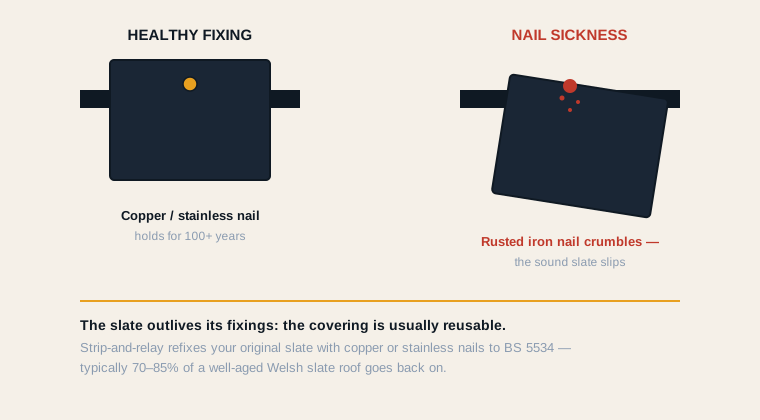
The comparison people usually miss is not natural versus synthetic — it is new-anything versus reusing what you already have. Natural Welsh slate is remarkably durable: the stone itself routinely outlasts the iron nails that hold it, so a Victorian Norwich roof that is dropping slates has usually not failed at all — its fixings have. In that situation the best-value answer is a strip-and-relay: we take the slate down, replace the perished underlay and battens, and re-fix 70 to 85 per cent of your original slate with new copper or stainless nails to BS 5534, buying only enough matched reclaimed slate to make up the shortfall. You keep the authentic material and the century of weathering that makes it look right, at a fraction of a full new-slate roof and often less than a synthetic re-roof too. Before you compare natural against synthetic, the real question is whether your existing slate can simply be re-laid — and on Norwich period stock, it very often can.
If you are genuinely re-roofing and considering synthetic, know that the category spans a wide quality range. At the top end, moulded composite slates taken from natural-slate masters can be convincing on the right modern house, carry decent guarantees, and hold colour reasonably well. At the bottom end, cheap fibre-cement or thin plastic imitations look flat and uniform, can fade or discolour, and rarely fool the eye on a period roof or satisfy a conservation officer. The price you are quoted usually tells you which end you are getting. On a modern property outside a conservation area, a good composite is a legitimate, sensible, lighter and cheaper choice; on a period roof in the Golden Triangle or Heigham, even a good synthetic tends to look like what it is, and the planners tend to agree.
A large share of Norwich’s slate roofs sit in conservation areas or on listed buildings, and there the choice is often made for you. Conservation policy generally requires like-for-like natural materials, so a natural-slate roof usually has to be repaired or re-laid in natural slate, and a switch to synthetic can be refused. This is not bureaucracy for its own sake — it protects the coherent look of streets whose value depends on it. The practical implication is that on a period or listed Norwich roof, natural slate (ideally your own, re-laid) is not just the better-looking option but frequently the only permitted one, and it is worth confirming the local designation before you plan any work. We check the conservation and listing status as part of the survey so there are no surprises at the planning stage.
The honest summary: before you even compare natural against synthetic, find out whether your existing slate can simply be re-laid — on Norwich period stock it very often can, and strip-and-relay of your own Welsh slate is frequently the best value and best-looking option of all. If you are genuinely re-roofing: choose natural slate for period and conservation property, where it is usually the required and the right material and will last a century-plus; choose a good-quality synthetic for a modern home outside a conservation area, where its lower cost and weight are real advantages. Avoid cheap composite on any roof you care about the look of. We check your slate’s condition and your property’s conservation status first, then recommend the option — re-lay, natural or synthetic — that is genuinely right for your roof and your budget.
Natural slate lasts far longer (80–120+ years vs 25–60), is authentic, and is usually required on Norwich period and conservation stock. Synthetic is lighter and cheaper and suits modern property. On period roofs natural slate is nearly always the better choice.
Usually, yes. Much of the Golden Triangle, Heigham and Norwich’s older terraces are conservation or listed, where natural slate is generally required and synthetic often is not accepted. We check before quoting.
Very often. Natural slate outlives its nails, so a slipping roof is usually a strip-and-relay that re-fixes 70–85% of your original slate with new copper or stainless nails — not a full replacement, and cheaper than either new natural or synthetic slate.
Good-quality composite slate can look convincing on the right modern property and costs less. Cheaper products can look plasticky and fade, and rarely convince on a period Norwich roof or satisfy conservation planners.
It varies widely by product — roughly 25–60 years — against 80–120+ years for natural slate. Check the specific manufacturer’s guarantee.
Synthetic is cheaper upfront (around £90–£160/m² installed vs £140–£280 for natural). But strip-and-relay of your existing natural slate can be the best value of all on a period roof.
Usually not, if your natural slate is sound. Switching is generally a downgrade in longevity and authenticity, and may not be permitted in a conservation area. We will give you the honest answer for your roof.
Related: clay vs concrete tiles. Ready? See slate roofing or repair or replace.
Free survey, written quote and a 10-year workmanship guarantee. Call now — no call-out fee.
0160 339 6191📅 Get My Free Quote