Where the insulation sits decides whether your flat roof stays dry — more than the covering does. An honest guide to warm versus cold deck for Norwich flat roofs, condensation and Building Regs.
Tell us the job in 30 seconds. No pushy sales, no call-out fee.
📞 Call Now: 0160 339 6191A warm deck puts insulation above the structural deck, keeping the structure dry with no ventilation needed — the current Building Regs standard for new flat roofs. A cold deck puts it between the joists and relies on a ventilated air gap that fails if blocked, causing condensation. Choose warm deck for almost all new and replacement roofs.
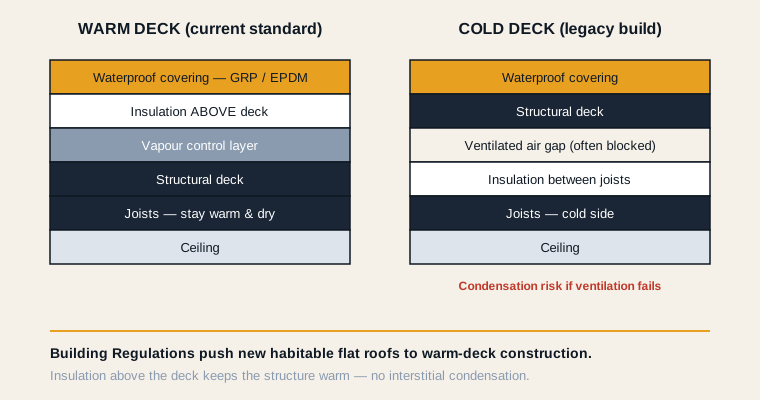
The words describe where the insulation sits in a flat roof, and it is the single most important decision in a flat-roof build — more important than the covering on top. In a warm deck, the insulation sits above the structural deck, keeping the whole structure warm and dry. In a cold deck (the older, legacy method), the insulation sits between the joists, below the deck, leaving the deck cold and requiring a ventilated air gap to carry away moisture. Get the build-up wrong and you get condensation — the “leak” with no hole — rotting the roof from the inside, no matter how good the covering.
| Factor | Warm deck | Cold deck (legacy) |
|---|---|---|
| Insulation position | Above the deck | Between the joists |
| Condensation risk | Low — structure stays warm | Higher — needs working ventilation |
| Ventilation needed | No | Yes — a ventilated air gap |
| Building Regs (new work) | Current standard | Generally not compliant for new |
| Roof height | Slightly higher build-up | Lower build-up |
| Reliability | More forgiving | Fails if ventilation blocks |
| Best for | New and replacement flat roofs | Existing roofs where height is fixed |
For almost all new and replacement flat roofs, the answer is warm deck. It is the current Building Regulations standard for habitable flat roofs, it is far more forgiving because it does not rely on a ventilation path staying clear, and it eliminates the interstitial condensation that destroys cold-deck roofs when the air gap blocks up. When we re-cover a Norwich flat roof — an extension, a dormer, a garage that has become a room — we almost always upgrade it to a warm-deck build-up as part of the job.
When cold deck is unavoidable: occasionally the roof height is fixed (a door threshold or window above, a planning height limit) and there is simply no room to add insulation on top. In that case a cold deck must be built and ventilated correctly, with the air gap kept clear — but it is the fallback, not the goal. If you have a cold-deck roof suffering “damp” that appears in cold weather and corners, the problem is almost certainly condensation from a failing air gap, not a covering leak, and re-covering alone will not fix it.
| Item | Typical cost |
|---|---|
| Warm-roof insulation upgrade (adds to a re-cover) | £400–£1,200 |
| Full warm-deck flat roof, extension | £2,200–£4,500 |
| Cold-deck ventilation correction | Per scope |
| Deck replacement (if rotted) | £400–£1,500 |
The warm-deck upgrade is a modest add to a re-cover and pays back by preventing condensation damage. 10-year workmanship guarantee; 20-year covering system guarantee. VAT confirmed in writing.
The reason warm deck has become the standard is a single, expensive failure mode: interstitial condensation. In a cold deck, warm moist air from the rooms below rises and meets the cold underside of the deck. Without a perfectly maintained ventilated air gap to carry that moisture away, it condenses — water forming inside the roof structure, out of sight, rotting timber and soaking insulation from within. Homeowners report it as a “leak” that appears in cold weather, worsens in winter, and shows in corners and along the ceiling edges rather than in a single spot after rain. There is no hole to find, because there is no leak — the water is being made inside the roof. Re-covering the top does nothing, because the covering was never the problem. A warm deck eliminates the mechanism entirely by keeping the whole structure above the dew point.
Current Building Regulations push new and replacement habitable flat roofs toward warm-deck construction, both for the condensation-avoidance reasons above and for thermal performance — a warm deck insulates the structure continuously, with fewer cold bridges. When we re-cover a flat roof that has become, or serves, a habitable space, upgrading to a compliant warm-deck build-up is normally part of doing the job properly, not an optional extra. It is also why a suspiciously cheap flat-roof quote is worth questioning: laying a new covering over an old, non-compliant cold deck may look like a saving, but it leaves the underlying condensation risk in place and does not meet the standard the regulations set for the work.
For most Norwich homeowners the practical takeaway is simple. If you are re-covering an extension, dormer or converted garage, plan for a warm deck — it is the reliable, compliant, condensation-proof choice, and the extra insulation cost is modest against the damage it prevents. If your existing flat roof shows cold-weather “damp” in corners, have it diagnosed before you spend on a new covering, because you may be about to pay to fix the wrong thing. And if the roof height genuinely cannot rise — a threshold or window sits too low — then a correctly built, properly ventilated cold deck is the honest fallback, done with the air gap kept clear and the vapour control right. We assess which applies to your roof and tell you plainly, rather than defaulting to whatever is quickest to lay.
The one thing to remember: on a flat roof, the deck build-up matters more than the covering on top. For almost any new or replacement flat roof, warm deck is the answer — compliant, condensation-proof, and forgiving because it does not depend on a ventilation gap staying clear for decades. Cold deck is the fallback for the rare case where the roof height simply cannot rise, and then only if it is built and ventilated correctly. If you take one action from this page, it is this: before you pay anyone to re-cover a flat roof that has shown cold-weather damp, get the cause diagnosed, because a new covering over an uncorrected cold deck is money spent on the wrong problem. We survey the build-up, not just the surface, and tell you what your roof actually needs.
In a warm deck the insulation sits above the structural deck, keeping the structure warm and dry with no ventilation needed. In a cold deck it sits between the joists below the deck, leaving the deck cold and requiring a ventilated air gap to prevent condensation.
Warm deck is better for almost all new and replacement flat roofs — it is the current Building Regs standard, needs no ventilation path, and avoids the condensation that destroys cold-deck roofs when the air gap blocks.
For new habitable flat roofs, warm deck is generally the compliant standard. We build to current Building Regulations and upgrade to warm deck on re-covers where the height allows.
Often not. Damp that appears in cold weather and in corners is usually interstitial condensation from a cold deck with a failing air gap, not a covering leak. Re-covering alone will not fix it — the build-up must be corrected.
Usually, but not always. If the roof height is fixed by a door threshold, window or planning limit, there may be no room to add insulation on top, in which case a correctly ventilated cold deck is the fallback.
As an addition to a re-cover, typically £400–£1,200 depending on area and insulation. It is a modest cost that prevents expensive condensation damage.
No — the deck build-up matters more. A perfect covering over a badly built cold deck will still suffer condensation. Get the warm-deck build-up right first, then the covering.
Related guides: EPDM vs GRP. Ready to proceed? See flat roofing in Norwich.
Free survey, written quote and a 10-year workmanship guarantee. Call now — no call-out fee.
0160 339 6191📅 Get My Free Quote