Clay Pantile — the Norwich Benchmark
Clay pantile is the original roofing material of historic Norwich and the longest-lasting of any material in common use in the city. A correctly fixed and maintained clay pantile roof will last 80-120 years — and many roofs in the Golden Triangle, Heigham and Lakenham have original or once-replaced pantile that is approaching or past this age. The tiles themselves rarely fail. What fails is the fixing nails — original iron fixings corrode progressively over 80-100 years until tiles begin to slip. Re-fixing with stainless nails when this begins extends the roof life by a further 20-30 years without re-roofing. A well-maintained clay pantile roof, re-fixed once, should last 120-150 years from first installation.
Concrete interlocking roof tiles carry a typical manufacturer design life of 30-50 years, though fixings and underlay often fail before the tiles themselves.
Source: manufacturer design-life data
Welsh Slate — the Period Alternative
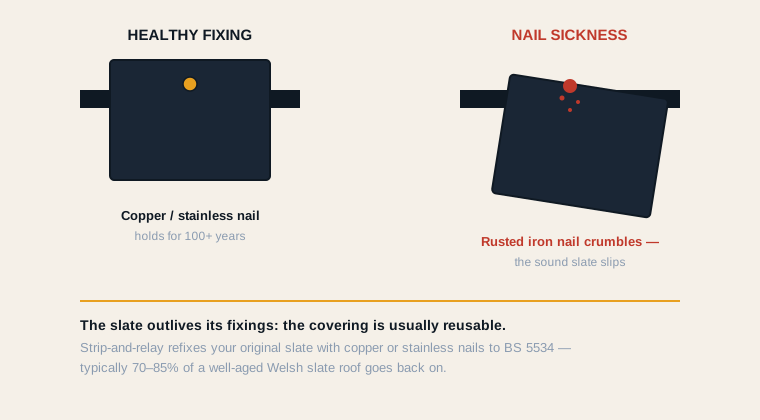
Welsh slate on Norwich's Edwardian and late-Victorian professional housing has a similar lifespan to clay pantile — 80-150 years for the slate itself, limited in practice by fixing nail corrosion. The key difference from pantile is that slate is more vulnerable to physical damage and requires more care during access work. A cracked slate cannot be re-fixed — it must be replaced. With matching natural Welsh slate sourced correctly, a slate roof can be maintained almost indefinitely through periodic tile replacement and re-fixing.
Concrete Interlocking Tile — Norwich Estate Housing
Concrete interlocking tile — the standard roofing material on Norwich's post-war estate housing from Mile Cross to Costessey — has a design life of 30-50 years. In practice, Norfolk's freeze-thaw cycling reduces this at the lower end of the range on exposed north or west-facing properties. Most 1960s-1970s estate housing in Norwich is now 50-60 years old — at or past the design life range. The tiles themselves may still be structurally sound, but the fixing nails will be heavily corroded, the surface will be porous, and the underlay will have failed. This is the age bracket where the question of repair versus replace becomes live.
Need a free survey or quote for your Norwich property?
Call 0160 339 6191 — Free QuoteFelt Flat Roofing — the Short-Life System
Standard built-up felt flat roofing has a design life of 10-20 years, making it the shortest-lived common roofing system in Norwich's housing stock. Most of the 1970s and 1980s flat-roofed extensions and garages across Norwich's estate suburbs are now at end of first or second felt life. GRP fibreglass, the modern alternative, has a design life of 25+ years and a 20-year material guarantee — it lasts roughly twice as long as felt under the same conditions. This is why felt replacement with felt is rarely the right long-term choice on Norwich residential flat roofs.
What Shortens Roof Life in Norfolk
Several local factors reduce roof lifespan below national averages: north-east coastal exposure accelerates mortar deterioration on ridge and hip lines; Wensum valley humidity accelerates lead corrosion and moss growth; the urban tree canopy blocks valleys and gutters faster than open locations; and the high proportion of period housing means original material and fixing ages are already high. Maintenance is the single biggest variable — a well-maintained roof lasts 30-50% longer than an equivalent unmaintained one. The most cost-effective maintenance is an annual gutter clear and a professional survey every 4-5 years.
Last reviewed: 2026-07-20 by Norwich Roofing Experts